
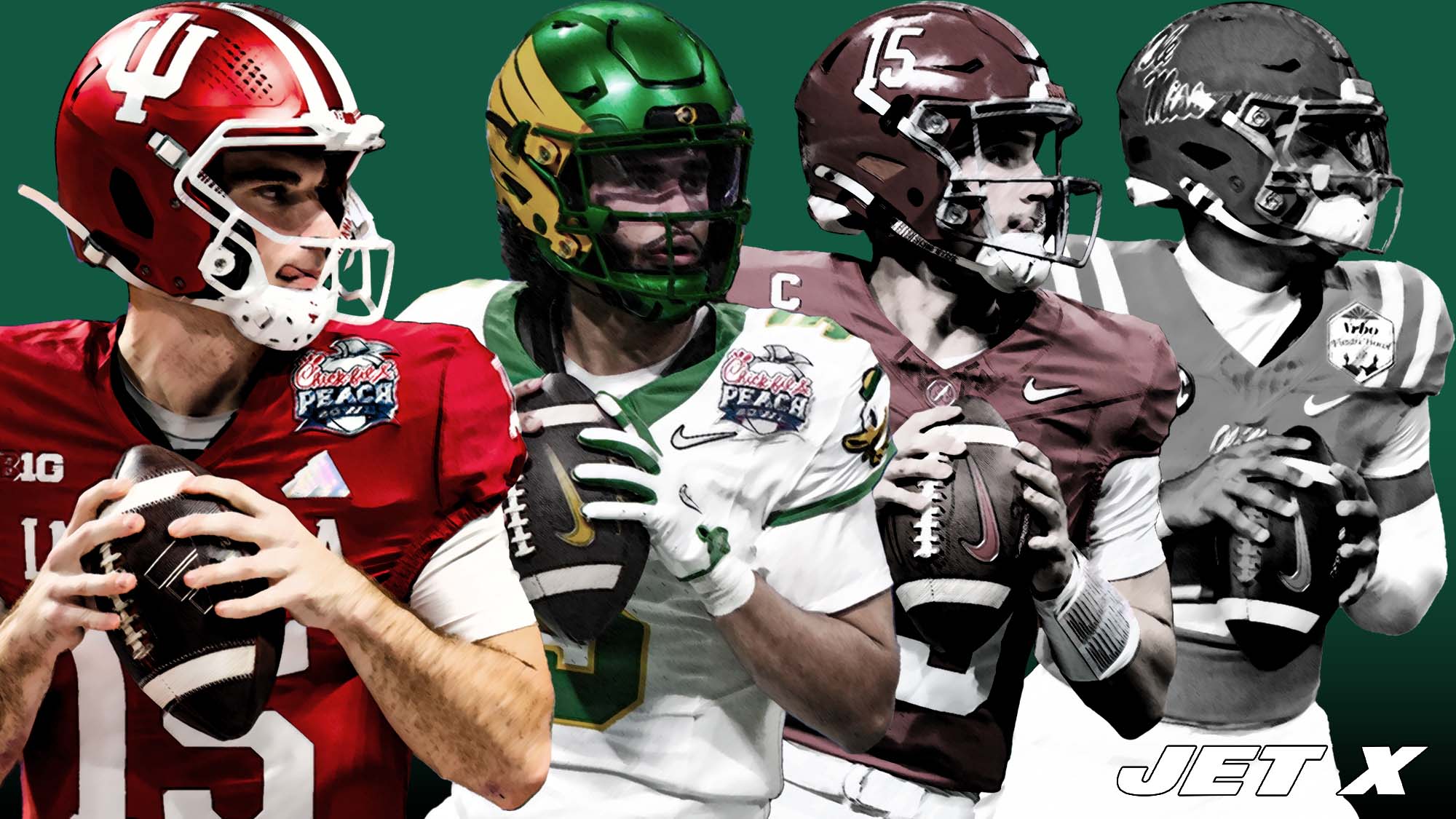
On Sunday, we analyzed the results of a study aimed at identifying metrics that could help predict the NFL success of potential first-round quarterback prospects.
While no metric proved to be an infallible fortune-teller, one in particular stood out as the most predictive.
Here’s the scary news for the New York Jets and other quarterback-needy teams around the league: None of the top quarterback prospects in the 2026 class meet the ideal threshold in this metric.
The most predictive metric for first-round quarterback prospects
Before we dive into the numbers on Fernando Mendoza and company, let’s quickly recap the methodology of the study, in case you didn’t read the original article (found here).
I analyzed the 35 quarterbacks chosen in the first round from 2015 to 2024. I charted each player’s performance in 21 different metrics during their final college seasons. Using this data, I calculated the correlation between each metric and NFL success.
To quantify “NFL success,” I combined each quarterback’s career regular-season performance in three metrics: passer rating, adjusted EPA per play, and overall Pro Football Focus grade. This gave us a one-number overall rating to represent the player’s NFL productivity. Using this rating, I calculated the average correlation between it and various college metrics.
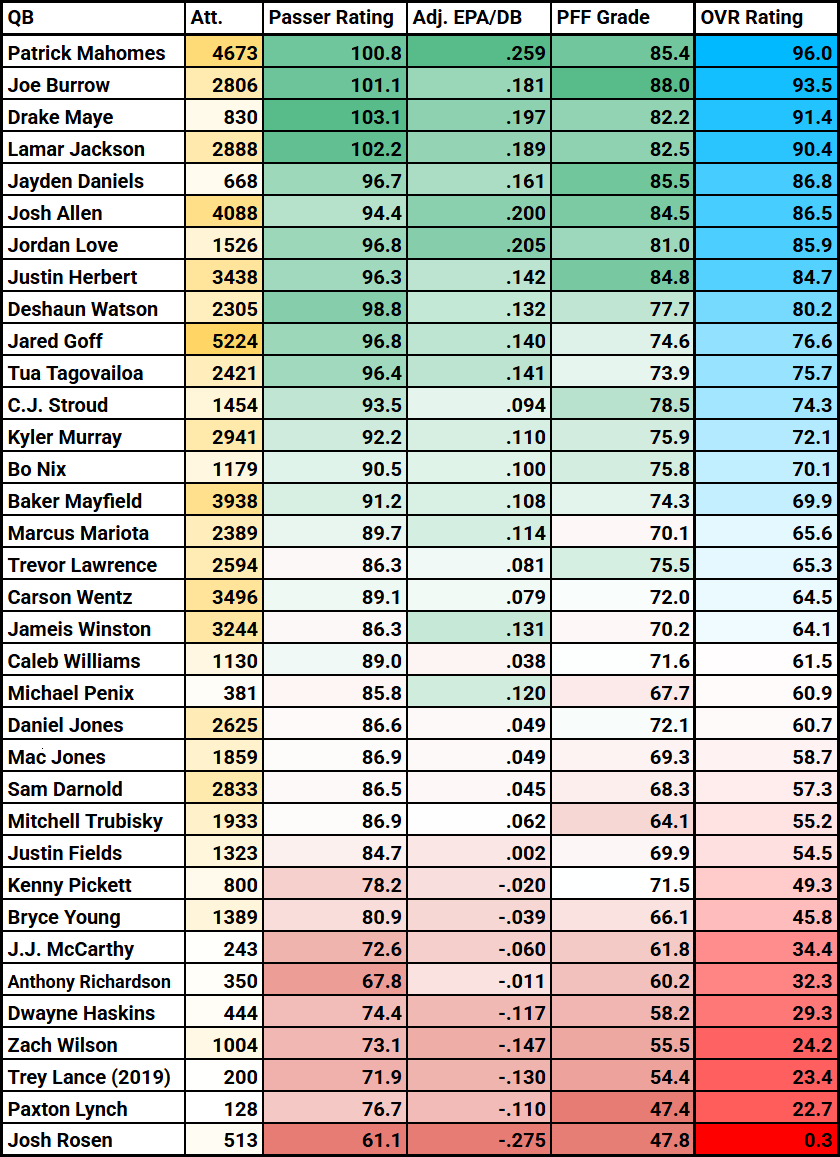
These were the 35 players involved in the study, along with their overall ratings (the group average was 61.8).
Using this 35-player sample, I calculated the correlation between overall rating and 21 different college metrics.
Seen below are the results, ranked by the correlation coefficient (r). For perspective, the closer the number is to 0.0 (no correlation), the weaker the relationship. The closer the number is to -1.0 (perfect negative correlation) or 1.0 (perfect positive correlation), the stronger the relationship.
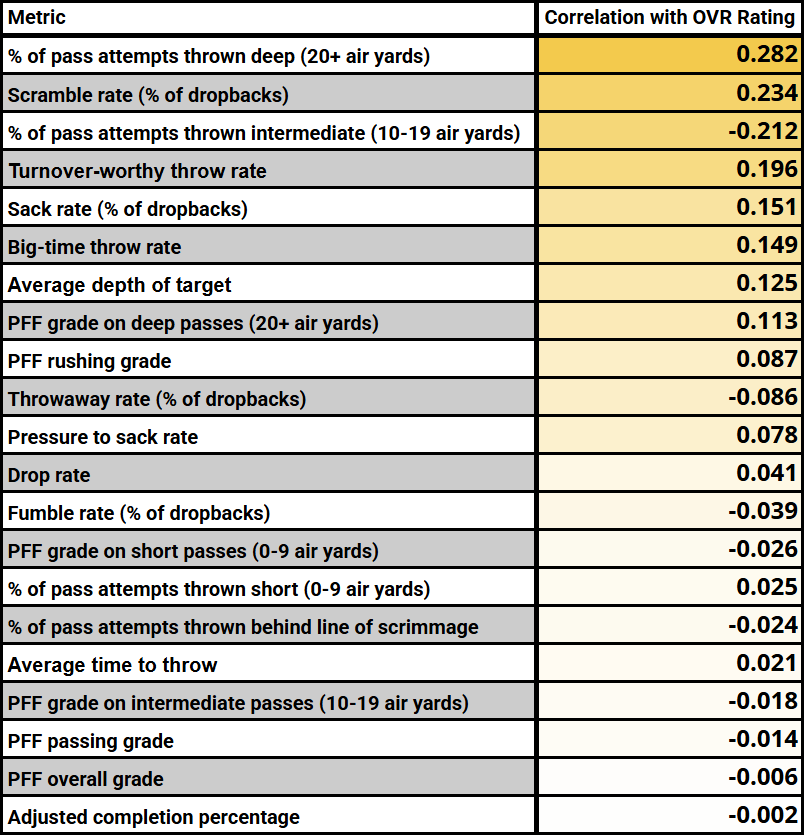
While no particular metric revealed itself as a scouting cheat code, there was a clear winner: deep pass attempt rate.
In other words, the percentage of a player’s total pass attempts that were thrown at least 20 yards past the line of scrimmage.
A critical threshold stood out among the 35 quarterbacks analyzed: 15%.
Quarterbacks with a deep pass attempt rate of 15% or higher were much more likely to succeed in the NFL. Those with a deep pass attempt rate below 15% have a very low success rate.
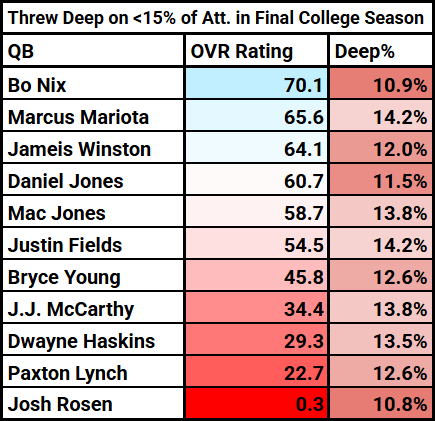
Of the 11 quarterbacks in the sample with a deep pass attempt rate below 15% in their final college season, the best among them is Bo Nix, whose 70.1 overall rating ranks just 14th out of 35 players. Among these 11 players, the average overall rating is a ghastly 46.0.
Compare this to the 24 quarterbacks with a deep pass attempt rate of at least 15%. Among this group, the average rating is 69.1, more than 23 points higher. Each of the 13 highest-rated overall quarterbacks met this benchmark.
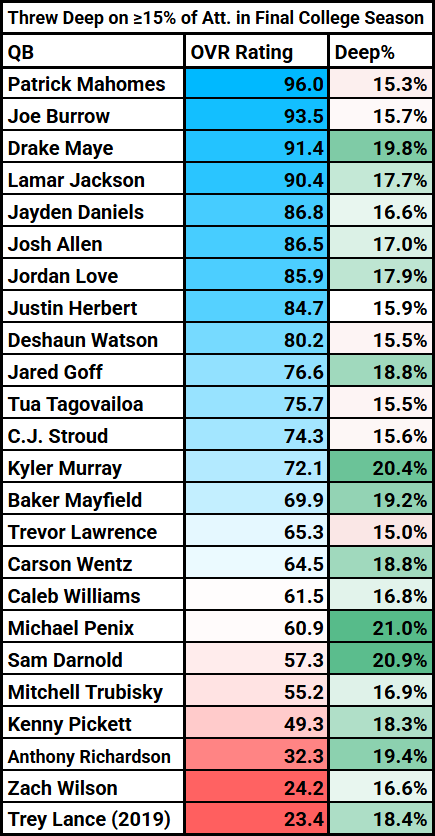
While this metric is far from a perfect tool for predicting success (there are busts on both ends of the spectrum), the results are still telling.
We’ve seen 11 first-round quarterbacks over the past decade-plus who entered the NFL after throwing deep at a very low rate in college, and none of them have gone on to become NFL stars (although Nix and Young are still TBD). Meanwhile, among the 24 players who have hit the 15% threshold, there are a plethora of stars, while the majority have at least become solid starters.
There are multiple theories as to why a prospect’s deep pass attempt rate is important. It could be an indicator of confidence, a signal of ceiling-raising potential, or a sign that the prospect hails from a more NFL-ready offense that was not predicated upon easy passes underneath.
Jets X-Factor’s Robby Sabo believes that the correlation makes sense because it indicates that the prospect had more legitimate, NFL-esque reps on tape. The higher the deep rate, the fewer three-step-drop/run-pass-option reps that provide little information about the prospect’s NFL chops. With more chances to scout a prospect in NFL-transferable situations, the odds of misevaluating him decrease.
So, how do some of the top quarterback prospects in the 2026 NFL draft fare in this key metric?
Deep pass attempt rates of the top 2026 QB prospects
We’ll be focusing on the following quarterback prospects; in parentheses is their current overall ranking on the consensus big board at NFL Mock Draft Database.
- Fernando Mendoza, Indiana (1)
- Dante Moore, Oregon (2)
- Ty Simpson, Alabama (20)
- Garrett Nussmeier, LSU (44)
- Cade Klubnik, Clemson (67)
- Carson Beck, Miami FL (107)
- Drew Allar, Penn State (113)
- John Mateer, Oklahoma (118)
- Trinidad Chambliss, Mississippi (122)
Not all of these quarterbacks are expected to be in the first-round conversation. However, with the desperation for quarterbacks around the NFL and the perceived weakness of this class, you never know which prospect might be taken surprisingly early by a desperate team. For that reason, it’s worth throwing some more names into this analysis, beyond just the consensus top prospects.
So, how many of these quarterbacks hit the all-important 15% deep pass attempt rate benchmark in the 2025 season?
Take a look.
- Fernando Mendoza, Indiana: 14.4%
- Dante Moore, Oregon: 13.3%
- Carson Beck, Miami FL: 13.3%
- Ty Simpson, Alabama: 13.1%
- John Mateer, Oklahoma: 12.7%
- Cade Klubnik, Clemson: 12.4%
- Trinidad Chambliss, Mississippi: 12.3%
- Garrett Nussmeier, LSU: 10.4%
- Drew Allar, Penn State: 8.2%
None.
Not one.
Mendoza comes the closest at 14.4%. He’s actually close enough to where he might be able to push through in the national championship game. If he were to throw his season average of 24 pass attempts, he could reach the 15% benchmark by throwing at least six deep passes.
However, Mendoza has rarely thrown deep against quality opponents this year. Across five games against ranked opponents, Mendoza has thrown just 14 deep passes, a measly 2.8 per game. Coming across 113 total pass attempts, he has a deep pass attempt rate of just 12.4% against ranked competition.
Other than Mendoza, nobody comes close to the 15% benchmark.
It only further supports the popular notion that this is a weak quarterback class. Deep pass attempt rate on its own is not a be-all and end-all for a prospect, but the data we examined is difficult to ignore. The 11-player sample of sub-15% players is not a group that any prospect should want to be in. As an NFL team, it’s difficult to look at that group of prospects and justify rolling the dice on another player in the same region.
Are there other predictive metrics?
Deep pass attempt rate was the most predictive metric of the 21 included in our analysis, but two other metrics stood out: turnover-worthy throw rate and scramble rate.
Turnover-worthy throw rate
As for turnover-worthy throws, there was actually a positive correlation with overall rating, meaning quarterbacks tended to be more successful in the NFL if they threw more turnover-worthy throws in college.
It could be related to the theories we discussed regarding deep pass attempt rate. Perhaps if a quarterback throws more dangerous passes in college, it indicates they are more confident, which increases their odds of NFL success. The negative results themselves can be coached out of a player, whether it’s through improved accuracy or sounder decision-making, but the confidence itself is difficult to teach.
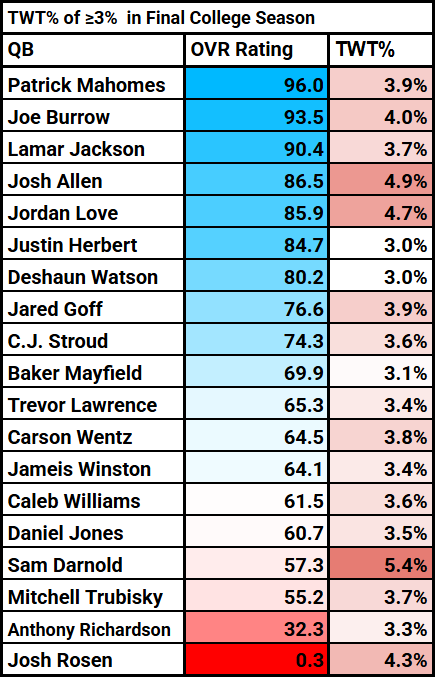
Of the 19 players in our sample who launched a turnover-worthy throw on at least 3% of their attempts in their final college season, the average overall rating was 68.4. Eight of the 10 highest-rated quarterbacks are in this group, including perennial stars like Patrick Mahomes, Joe Burrow, Lamar Jackson, and Josh Allen.
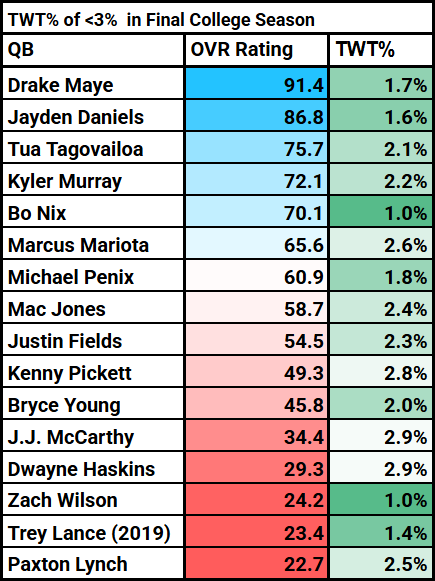
Meanwhile, among the 15 players with a turnover-worthy throw rate below 3%, the average overall rating was 54.0, more than 14 points lower. Drake Maye and Jayden Daniels are the only players in this group with top-10 overall ratings.
How does the 2026 class fare?
- John Mateer, Oklahoma: 4.1%
- Ty Simpson, Alabama: 3.0%
- Garrett Nussmeier, LSU: 3.0%
- Dante Moore, Oregon: 2.7%
- Drew Allar, Penn State: 2.6%
- Fernando Mendoza, Indiana: 2.5%
- Trinidad Chambliss, Mississippi: 2.3%
- Cade Klubnik, Clemson: 2.2%
- Carson Beck, Miami FL: 1.9%
Only three of the nine players reached the benchmark. Among those receiving legitimate first-round consideration, only Ty Simpson hit it, and barely.
Scramble rate
Finally, there was a decent correlation between NFL success and a prospect’s tendency to scramble in college.
“Scramble rate” is the percentage of passing dropbacks in which the quarterback elected to tuck the ball and rush.
While this metric cannot eliminate potential busts, it has proven critical in identifying prospects with MVP-type potential. Each of the six highest-rated quarterbacks in the 35-man sample—Patrick Mahomes, Joe Burrow, Drake Maye, Lamar Jackson, Jayden Daniels, and Josh Allen—had a scramble rate of at least 7% in their final college season.
Among the 13 players with a college scramble rate of at least 7%, the average overall rating was 68.3. The group features three MVPs (potentially four if Drake Maye wins this year) and six total quarterbacks with an 80.0+ rating, a 46% star chance out of 13 players. There are still plenty of busts in here, though.
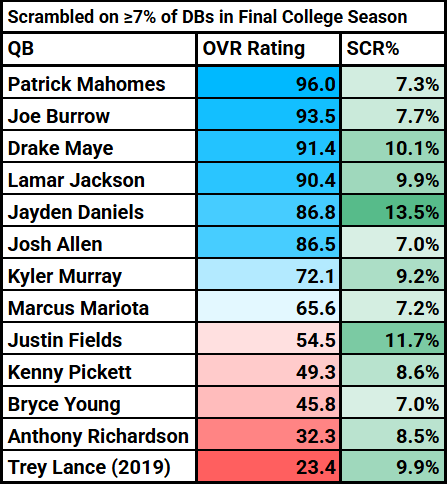
There was a large gap in scramble rate between the top scramblers and the rest of the pack; the next-highest rate beneath the 7% threshold was 5.2%. Among the 22 players below 7%, the average overall rating was 58.0, more than 10 points lower. Just three of the 22 players have an 80.0+ rating, a 14% star chance.
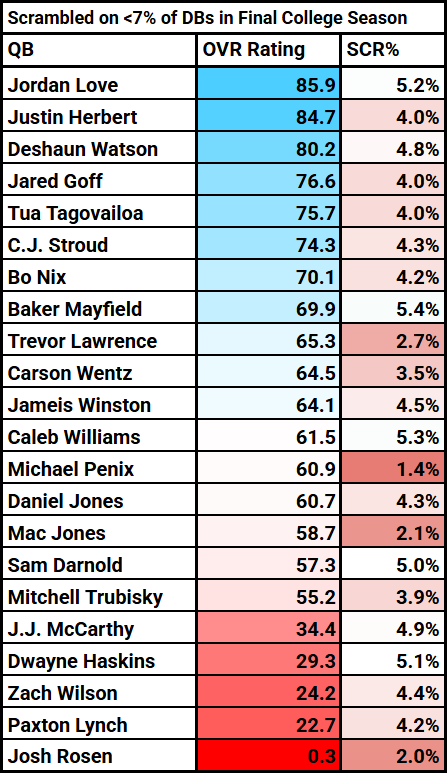
Busts can be found in both groups, but the odds of landing a star are much higher if you draft a quarterback who scrambled at least 7% of the time in college.
Let’s see how the 2026 class fared.
- Drew Allar, Penn State: 10.8%
- Fernando Mendoza, Indiana: 7.8%
- Carson Beck, Miami FL: 6.5%
- John Mateer, Oklahoma: 6.1%
- Ty Simpson, Alabama: 6.1%
- Trinidad Chambliss, Mississippi: 4.9%
- Dante Moore, Oregon: 4.8%
- Cade Klubnik, Clemson: 3.7%
- Garrett Nussmeier, LSU: 2.3%
Only Allar and Mendoza hit the benchmark. A few other quarterbacks eclipsed 6%, which is still above-average, but it’s the 7% mark that has been consistently reached by the greatest first-round hits of the past decade.
What does this mean for the 2026 quarterback class?
Firstly, the players outside of the first-round conversation did not show us enough to prove they are worthy of sneaking into the first round. None of the “sleeper” prospects performed well across all three predictive metrics.
Based on this, it seems likely that the sleepers will stay put with their post-first-round projections. That does not rule them out from succeeding in the NFL, but they certainly do not profile as first-rounders.
The most critical takeaway, though, is that even the consensus first-round prospects do not appear to have strong chances of success.
Three quarterbacks are in the conversation to be selected by the New York Jets in the first round: Fernando Mendoza, Dante Moore, and Ty Simpson. Based on the metrics we looked at today, none of these players is a good bet to succeed.
We highlighted three critical boxes to check:
- ≥15% deep pass attempt rate
- ≥3% turnover-worthy throw rate
- ≥7% scramble rate
Mendoza (scramble rate) and Simpson (turnover-worthy rate) each checked one of three boxes. Moore checked none.
That’s a bad sign for all three players, especially Moore.
If we divide the 35-player sample into four tiers based on the number of boxes checked, take a look at the correlation with NFL success:
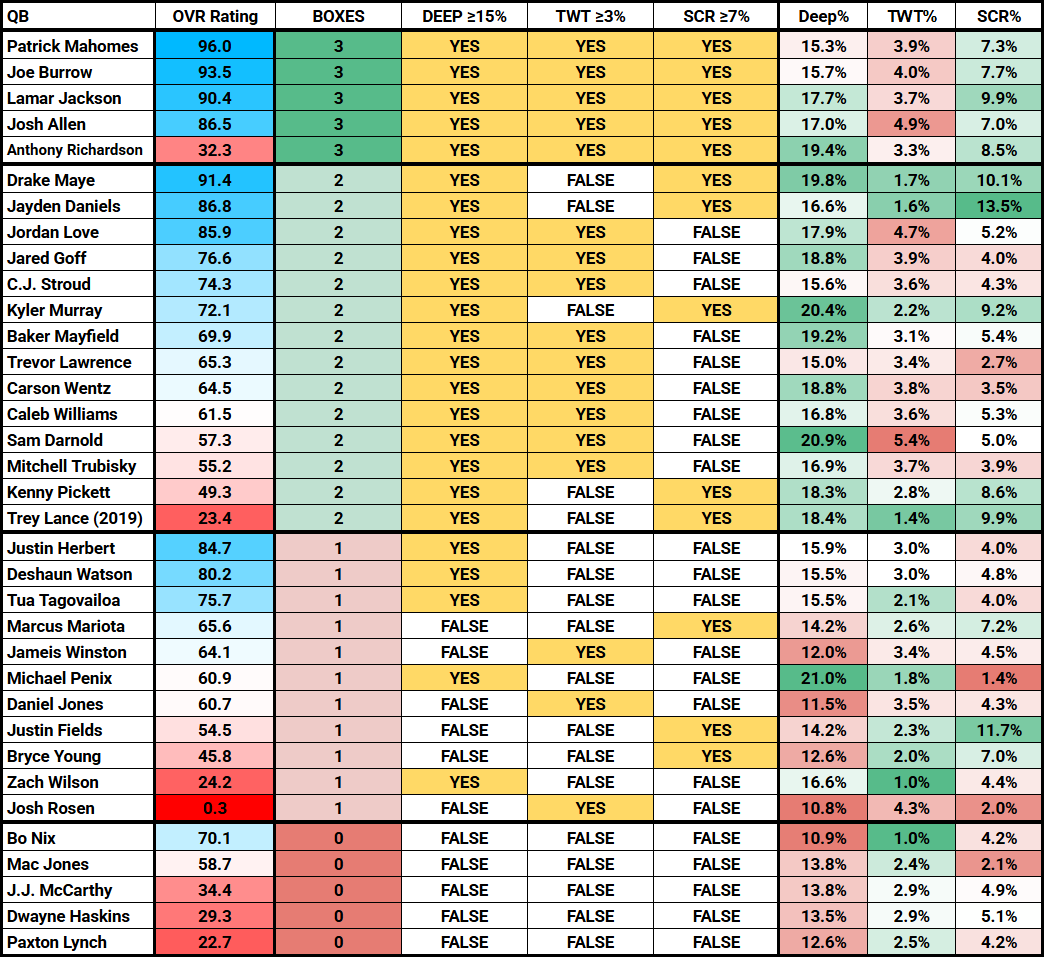
These were the average overall ratings for each group:
- 3 of 3 boxes checked: 79.8
- 2 of 3 boxes checked: 66.7
- 1 of 3 boxes checked: 56.1
- 0 of 3 boxes checked: 43.0
There was a correlation coefficient of 0.464 between overall rating and the number of boxes checked. Now that is something meaningful.
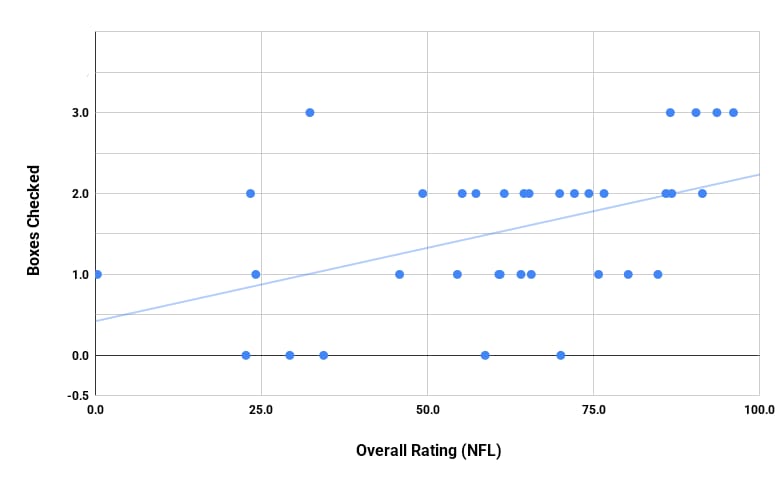
Each metric in itself had a fairly weak correlation with NFL success, but after blending them together, we have found a pretty solid formula for projecting the odds of NFL success.
And it isn’t kind to the headliners of the 2026 class.
As “one-box” players, Mendoza and Simpson are set to join an 11-player group in which the only quality starter as of today is Justin Herbert. In fact, the odds are even bleaker for them, as neither had deep pass attempt rate as the sole box checked.
Each of the three highest-rated one-boxers (Herbert, Deshaun Watson, and Tua Tagovailoa) had deep pass attempt rate as their only box checked. Among the six one-boxers whose lone box was either turnover-worthy throw rate (Simpson’s case) or scramble rate (Mendoza’s case), the average overall rating was 48.5, with the best player being Marcus Mariota:
- Marcus Mariota
- Jameis Winston
- Daniel Jones
- Justin Fields
- Bryce Young
- Josh Rosen
Things are looking even worse for Moore. These are the five players who failed to meet any of the three thresholds we laid out:
- Bo Nix
- Mac Jones
- J.J. McCarthy
- Dwayne Haskins
- Paxton Lynch
This is as good a sign as any that Moore would be wise to return to Oregon for the 2026 season, a decision that remains in limbo.
It is also worth noting that Ole Miss quarterback Trinidad Chambliss, who is receiving newfound first-round buzz after a red-hot playoff run and a denied request for a sixth year of college eligibility, also failed to check any of the three boxes. It further affirms that he isn’t a first-round prospect, along with obvious concerns, such as his small frame.
As for Mendoza and Simpson, their projections leave the NFL’s quarterback-needy teams in a quandary. Teams like the Raiders and the Jets will feel pressured into making a quarterback move out of necessity, but as we learned in today’s breakdown, the top of this class is weak. In many other drafts, Simpson would not get first-round talk, while Mendoza would not be in the mix for the first overall pick.
The interesting caveat for Mendoza is that he still has one game left to improve his profile. If he chucks up some bombs and confident-yet-dangerous throws against Miami in the biggest game of his life, his projection could look a lot more favorable by next week.
It might not matter for the Jets, though, as Mendoza could be in silver-and-black by the time New York is on the clock at No. 2. This becomes especially likely if he improves his stock once again in the national championship.
Unlike Mendoza, Simpson’s season is over, so his statistical profile is set in stone. He’s also declared for the draft already, eliminating his chance to return to school and improve his stock.
If Mendoza goes first overall to Las Vegas, Simpson might be the Jets’ best quarterback option on the board, even if Moore declares. For a quarterback-needy team picking second overall, that is not an ideal situation to be in.
The Jets are left with a choice: Force a quarterback selection on a prospect whose odds of success certainly do not warrant the second overall choice, or go in a different direction with the pick?
Instead of reaching for a quarterback at No. 2, the Jets could select the best player available or trade down. Then, New York could try to target Simpson or Moore later in the first round, or they could wait until after the first round to target a quarterback when the draft slot makes sense for the odds of success.
At No. 2, though, it is tough to justify the gamble on Simpson or Moore. Neither player’s college tendencies suggest they have a high enough chance of working out to warrant being selected with the second overall pick. It is a difficult reality for a quarterback-needy team that endured a historically bad season to earn this draft slot, one that has yielded players like Jayden Daniels and C.J. Stroud in recent years.
As for Mendoza, his profile seems more justifiable to gamble on in the top two, and it could look better after his final game. However, it appears that Mendoza probably does not deserve the slam-dunk, can’t-miss hype that he is getting in the national media. As things stand, even Mendoza does not project to have strong odds of NFL success.
New York has plenty to ponder over the next few months. As they mull their quarterback plan, they would be wise to rely on the data trends of recent NFL drafts to give themselves the best shot of making the right decision. There will never be a perfect formula that can predict a prospect’s exact future, but there are ways to tilt the odds in your favor, and we discovered one of them today.
