
On Sunday, we set out to identify the best metrics for predicting the future success of first-round EDGE prospects in the NFL draft.
The takeaways could change the way you view the EDGE scouting process.
There was an obvious correlation between college production and NFL success. Simply put, the more dominant the prospect was in his final college season, the likelier it was that he would succeed in the NFL—with a relatively high degree of certainty.
You might be thinking, “Well, obviously!” But not so fast. We ran the same study for first-round quarterbacks, and there was zero correlation whatsoever between college production and NFL success. Rather, for quarterbacks, it is the metrics that indicate a player’s tendencies and habits that send the most reliable signals about his future.
For edge rushers, though, the formula is simple: If you can make plays at a high rate in college, you are likely to do the same in the NFL, and if you couldn’t make plays at a high rate in college, you are unlikely to do it in the NFL—even if you display superhuman physical traits at the Underwear Olympics.
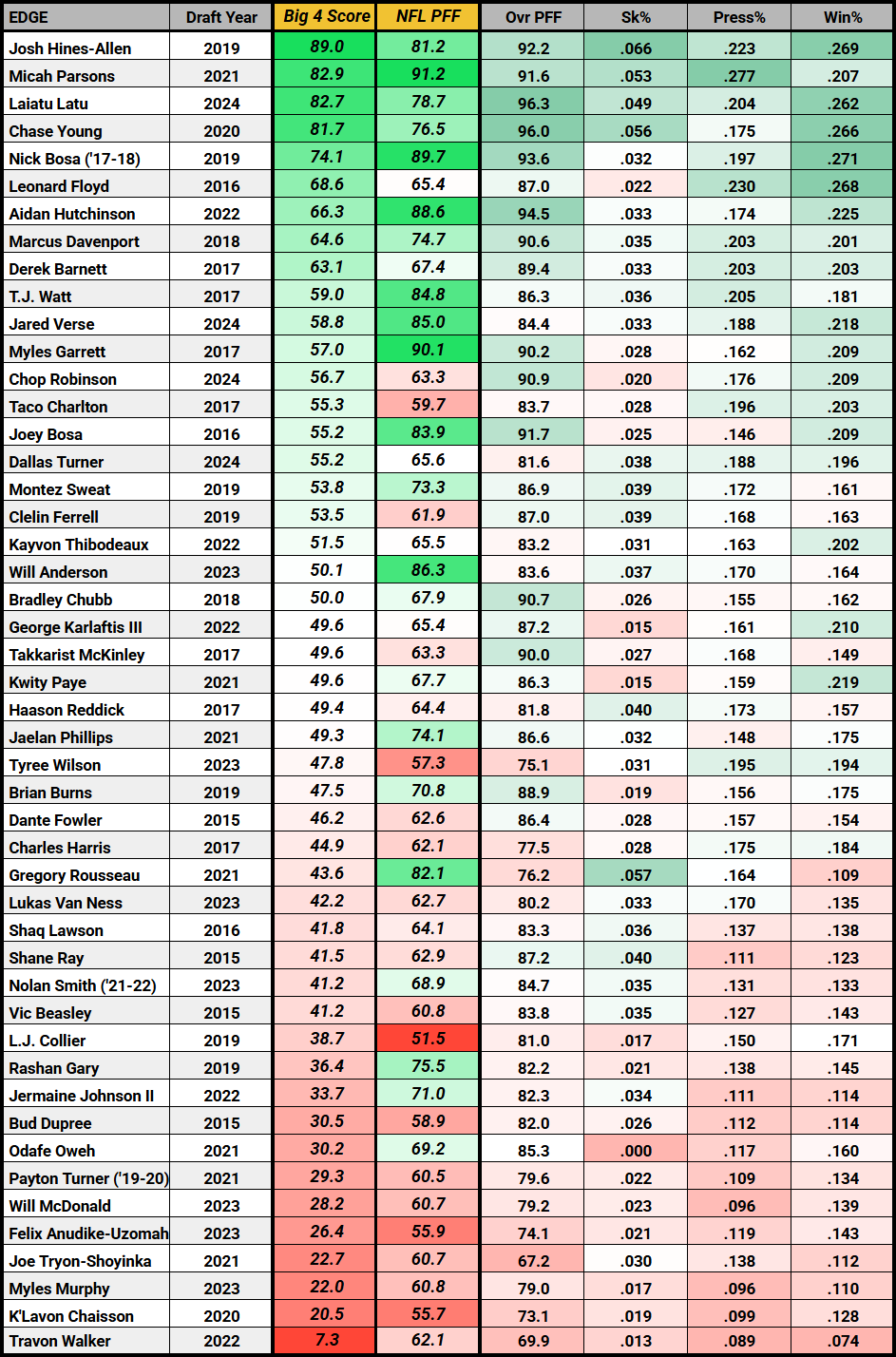
Across the 48 edge rushers chosen in the first round from 2015 to 2024, four metrics from players’ final college seasons correlated the most with players’ career Pro Football Focus grades in the NFL: overall PFF grade, sack rate, pressure rate, and pass-rush win rate.
We combined these four metrics into a “Big 4 Score” that ranges from 0 to 100, quantifying how well the player performed across the most predictive metrics. The correlation between Big 4 Score and NFL PFF grade was stunningly strong.

Here is the list of 48 first-round edge rushers from 2015 to 2024. Their Big 4 Score is shown alongside their NFL PFF grade to showcase the correlation between the two. On the right side of the table are the four final-college-season metrics that are combined to generate the Big 4 Score: overall PFF grade, sack rate, pressure rate, and pass-rush win rate.
Now that we have this information at our disposal, it’s time to apply it to the 2026 NFL draft class.
Who is the likeliest edge rusher to succeed in this year’s draft? Well, based on Big 4 Score, one clear answer stands out.
We’ll have to break down the numbers to figure out who it is.
Players studied
This analysis is intended for first-round prospects; while we don’t know at this point who will be selected in the first round, we can focus our analysis on players who have a chance to be.
I analyzed the top 10 EDGE prospects on NFL Mock Draft Database’s consensus big board as of Jan. 19, 2026, plus Ohio State linebacker Arvell Reese, who is projected to transition to the edge in the NFL. That gives us the following 11 players, ranked by their overall placement on the consensus big board:
- 2. Arvell Reese, Ohio State
- 3. Rueben Bain, Miami (FL)
- 9. David Bailey, Texas Tech
- 11. Keldric Faulk, Auburn
- 22. Cashius Howell, Texas A&M
- 27. T.J. Parker, Clemson
- 36. Romello Height, Texas Tech
- 38. Akheem Mesidor, Miami (FL)
- 39. R Mason Thomas, Oklahoma
- 42. LT Overton, Alabama
- 54. Zion Young, Missouri
First, we’ll rank the prospects in each of the four metrics. Then, we will bring the metrics together to rank the prospects by their Big 4 Scores. After that, we’ll identify the closest comparisons for each prospect among first-rounders chosen from 2015 to 2024.
Overall PFF grade
- (9) David Bailey, Texas Tech: 93.3
- (3) Rueben Bain, Miami (FL): 93.1
- (36) Romello Height, Texas Tech: 92.5
- (38) Akheem Mesidor, Miami (FL): 92.1
- (39) R Mason Thomas, Oklahoma: 85.3
- (54) Zion Young, Missouri: 85.0
- (22) Cashius Howell, Texas A&M: 81.2
- (27) T.J. Parker, Clemson: 80.7
- (2) Arvell Reese, Ohio State: 76.4
- (11) Keldric Faulk, Auburn: 75.8
- (42) LT Overton, Alabama: 64.2
- Group average among 48 first-rounders from 2015 to 2024: 84.6
There is a big drop-off between the fourth and fifth spots. Only four prospects hit the coveted 90.0 mark: Bailey, Bain, Height, and Mesidor.
The 90.0 club is a promising one to be in. Of the 48-player sample of first-round picks, only 12 had a 90.0+ PFF grade in their final college season. Among those, the average career NFL PFF grade is 80.5, with 10 of the 12 players exceeding a 74.0 mark. This club includes players like Myles Garrett, Micah Parsons, Nick Bosa, Aidan Hutchinson, Josh Hines-Allen, and Joey Bosa.
Perhaps the most glaring result here is the relatively poor 76.4 mark from Arvell Reese, which, for a projected first-rounder, is very low against collegiate competition.
In fairness to Reese, his low PFF grade is mostly due to his 56.4 grade in coverage. Since he played 38.2% of his defensive snaps in coverage, it had a large impact on his overall grade. In the NFL, though, Reese probably won’t be playing nearly as much in coverage.
However, even Reese’s pass-rush grade was an unimpressive 72.1. Among the 48-player sample, only four prospects had a worse mark: Felix Anudike-Uzomah, Rashan Gary, Joe Tryon-Shoyinka, and Travon Walker.
As we will see in the next few sections, Reese’s raw production and efficiency as a pass rusher were excellent, but his grade is probably low due to the lack of true pass-rushing reps on his tape. Many of his pressures were schemed-up pressures via the blitz from off-ball linebacker alignments, which won’t yield as high a grade as true one-on-one wins off the edge. Reese recorded these reps occasionally, but not enough to pump up his grade.
Reese draws comparisons to former Penn State product Micah Parsons, who was a similar prospect; Parsons played off-ball linebacker in college but projected as an NFL edge rusher due to the ceiling he displayed as a pass rusher. Parsons, though, foretold his NFL dominance with a sparkling 91.6 overall PFF grade and 86.8 pass-rush grade in his final season at Penn State, despite having the same excuse about a lack of true pass-rush opportunities.
We shall see whether Reese’s relatively underwhelming college grades go down as a warning sign that teams should have heeded. As silly as it may seem to hold a subjective grading system against a prospect, there is pretty strong evidence that it matters.
Pressure rate
Percentage of a player’s pass-rush snaps in which they recorded any type of pressure (sack, hit, or hurry)
- (2) Arvell Reese, Ohio State: 22.3%
- (9) David Bailey, Texas Tech: 21.3%
- (36) Romello Height, Texas Tech: 17.7%
- (54) Zion Young, Missouri: 17.2%
- (3) Rueben Bain, Miami (FL): 17.2%
- (38) Akheem Mesidor, Miami (FL): 15.3%
- (39) R Mason Thomas, Oklahoma: 14.7%
- (22) Cashius Howell, Texas A&M: 13.6%
- (27) T.J. Parker, Clemson: 12.7%
- (11) Keldric Faulk, Auburn: 9.5%
- (42) LT Overton, Alabama: 9.4%
- Group average among 48 first-rounders from 2015 to 2024: 16.0%
Reese stands out as dominant in this category. He consistently got home when given chances to do so, although, as we discussed, not all of those were true pass-rushing reps off the edge.
Nonetheless, the only first-round EDGE prospects from 2015 to 2024 with a higher pressure rate than Reese’s 22.3% are Leonard Floyd (23%) and Micah Parsons (27.7%), with Josh Hines-Allen tying him and T.J. Watt right behind them (20.5%).
Bailey (21.3%) is in that neighborhood as well.
After Reese and Bailey, there is a large drop-off, with three other players performing above-average and the rest falling below the 16% group average.
This is a daunting sign for Faulk, a possible top-15 pick. Of the 48-player sample, only four had a pressure rate below 10%, and they have gone on to have an average PFF grade of 59.8 in the NFL, which is the stuff of a backup.
Sack rate
Percentage of a player’s pass-rush snaps in which they recorded a sack
- (2) Arvell Reese, Ohio State: 6.6%
- (9) David Bailey, Texas Tech: 4.0%
- (22) Cashius Howell, Texas A&M: 3.9%
- (39) R Mason Thomas, Oklahoma: 3.1%
- (38) Akheem Mesidor, Miami (FL): 2.6%
- (36) Romello Height, Texas Tech: 2.6%
- (54) Zion Young, Missouri: 2.5%
- (3) Rueben Bain, Miami (FL): 2.1%
- (42) LT Overton, Alabama: 2.0%
- (27) T.J. Parker, Clemson: 1.9%
- (11) Keldric Faulk, Auburn: 0.6%
- Group average among 48 first-rounders from 2015 to 2024: 3.1%
Sacks are not this class’s forté, with just four of the 11 players posting a sack rate above the average 3.1% mark for the 48-player sample.
Reese was an absolute demon when it came to turning his pass-rush opportunities into sacks. He contributed to eight sacks across just 121 pass-rush snaps. Reese’s 6.6% sack rate would tie Josh Hines-Allen for the best among first-rounders in the data sample.
Bailey continues to thrive in these metrics, posting an impressive 4% sack rate as a true edge rusher. The only players in the sample with a higher sack rate are Micah Parsons (4.9%), Chase Young (5.3%), Gregory Rousseau (5.7%), and Hines-Allen.
Bain’s relatively low 2.1% sack rate could raise questions about his ceiling compared to Reese, his primary rival in the Jets’ second-overall-pick debate.
It is not a death sentence for Bain’s superstar chances, as NFL sack artists like Myles Garrett (2.8%), Joey Bosa (2.5%), and Brian Burns (1.9%) also had below-average sack rates compared to their peers, but it isn’t ideal for a potential No. 2 pick. Of the 10 best players in the 48-man sample based on NFL PFF grade, eight of them had a sack rate of at least 3% in their final college season, with Garrett and Bosa being the exceptions. Even so, both had a higher rate than Bain.
While Bain has been in on 11 sacks this year, he needed an absurdly large sample of reps to get there, logging 522 pass-rush snaps across the Hurricanes’ 15 games (with a 16th coming up tonight).
Pass-rush win rate
Percentage of a player’s pass-rush snaps in which they defeated their blocker in a sufficient amount of time
- (3) Rueben Bain, Miami (FL): 24.0%
- (36) Romello Height, Texas Tech: 21.8%
- (9) David Bailey, Texas Tech: 21.6%
- (38) Akheem Mesidor, Miami (FL): 21.2%
- (39) R Mason Thomas, Oklahoma: 20.3%
- (22) Cashius Howell, Texas A&M: 19.8%
- (54) Zion Young, Missouri: 17.2%
- (27) T.J. Parker, Clemson: 15.5%
- (2) Arvell Reese, Ohio State: 13.7%
- (11) Keldric Faulk, Auburn: 11.6%
- (42) LT Overton, Alabama: 8.8%
- Group average among 48 first-rounders from 2015 to 2024: 17.5%
Bain makes up for his lower sack rate with an elite pass-rush win rate. The only players in the 48-man sample with a better pass-rush win rate are Laiatu Latu (26.2%), Chase Young (26.6%), Leonard Floyd (26.8%), Josh Hines-Allen (26.9%), and Nick Bosa (27.1%), with Aidan Hutchinson (22.5%) right behind.
Bailey has been excellent across all four metrics… is that a spoiler?
Height has also impressed relative to his big-board rank.
Here, we can see part of why Reese’s PFF grade was low. While he racked up sacks and pressures at an extremely high rate, his low pass-rush win rate suggests that he was not recording many true one-on-one wins to make those plays. The disparity between his sack/pressure rates and his win rate tells us that many of his sacks and pressures were either schemed-up or came on hustle/clean-up plays.
Big 4 Score
Let’s combine these four metrics into one 0-100 rating, the “Big 4 Score”, which has featured an eye-popping correlation coefficient of 0.624 with NFL PFF grade among the 48 first-round edge rushers from 2015 to 2024.
The better a potential first-round prospect fares in this metric, the likelier he is to succeed in the NFL.
- (9) David Bailey, Texas Tech: 71.8
- (36) Romello Height, Texas Tech: 61.4
- (3) Rueben Bain, Miami (FL): 59.7
- (2) Arvell Reese, Ohio State: 58.6
- (38) Akheem Mesidor, Miami (FL): 57.2
- (39) R Mason Thomas, Oklahoma: 51.2
- (22) Cashius Howell, Texas A&M: 48.7
- (54) Zion Young, Missouri: 48.0
- (27) T.J. Parker, Clemson: 33.9
- (11) Keldric Faulk, Auburn: 15.9
- (42) LT Overton, Alabama: 7.2
- Group average among 48 first-rounders from 2015 to 2024: 48.8
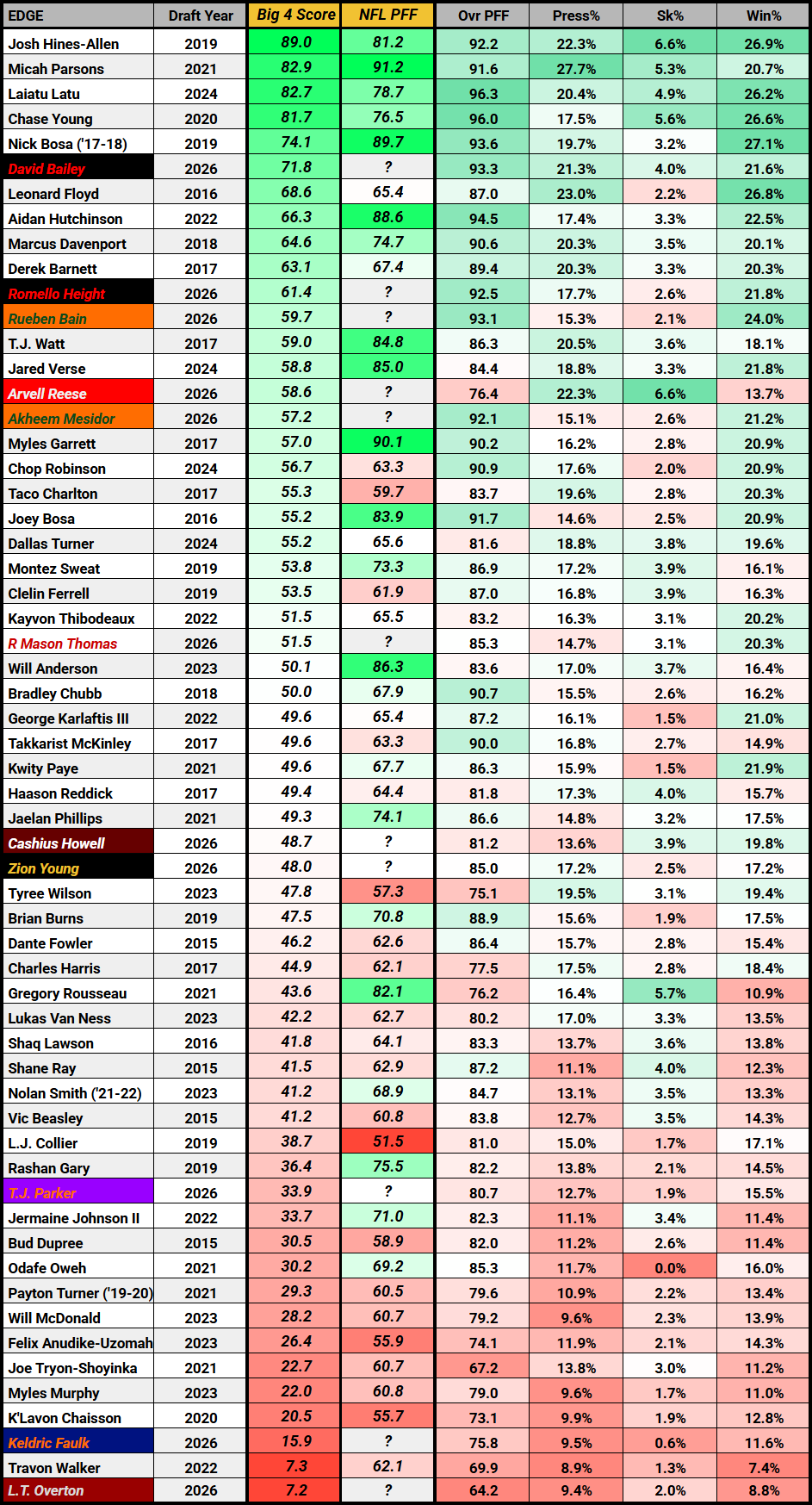
We have a clear-cut winner: Texas Tech’s David Bailey.
Bailey’s teammate, Romello Height, stands out as the greatest potential steal of this batch.
Bain and Reese may have underperformed relative to their draft stock, but their scores are still elite. If we slid them into the 48-player sample, their 59.7 and 58.6 scores would rank 10th and 12th, respectively, with the players in between them being T.J. Watt and Jared Verse.
Mesidor and Thomas round out the above-average first-round prospects in this formula. Howell and Young are borderline first-round-worthy. Teams should run like the wind to get away from Parker, Faulk, and Overton.
Let’s plug these players into the 48-man group to visualize how their resumes stack up against the prospects of the last 10-plus years.
Should Jets fans be talking more about Bailey as an option for the second overall pick?
Similarity Scores
To wrap up our deep dive, let’s identify the most comparable 2015-24 prospects to some of the top-rated prospects from the 2026 class.
We are going to use the same “similarity score” formula that we used for quarterbacks.
I calculated similarity scores between each of the 48 prospects in our data sample and the 11 prospects from the 2026 class that we analyzed today.
For all four of overall PFF grade, pressure rate, sack rate, and pass-rush win rate, I compared how far away each 2015-2024 prospect was from the 2026 prospect in question. Then, I averaged their separation across all four metrics, yielding a single-number similarity score.
Let’s run through the top five most similar prospects for five of the most noteworthy 2026 prospects. We will also list the correlation coefficient between the similarity scores for each prospect and NFL PFF grade; in other words, do the 2015-2024 prospects tend to perform better or worse in the NFL as they get more similar to this prospect?
David Bailey, Texas Tech
- Marcus Davenport (NFL PFF grade: 74.7)
- Derek Barnett (67.4)
- Aidan Hutchinson (88.6)
- Nick Bosa (89.7)
- T.J. Watt (84.8)
- Correlation Coefficient between Bailey SIM score and NFL PFF grade: 0.529
These are some pretty darn good signs. Three of Bailey’s top five comps are NFL superstars, and even one of the other two, Marcus Davenport, has shown Pro Bowl-caliber signs when healthy, but had his career derailed by injuries. Derek Barnett isn’t too bad as a floor, either.
The 0.529 correlation between Bailey’s SIM score and NFL PFF grade is the strongest positive correlation of any player we will analyze in this section, and it isn’t even close. Prospects that accomplish what Bailey accomplished are not necessarily guaranteed to work out, but the hit rate is high, and the ceiling is even higher.
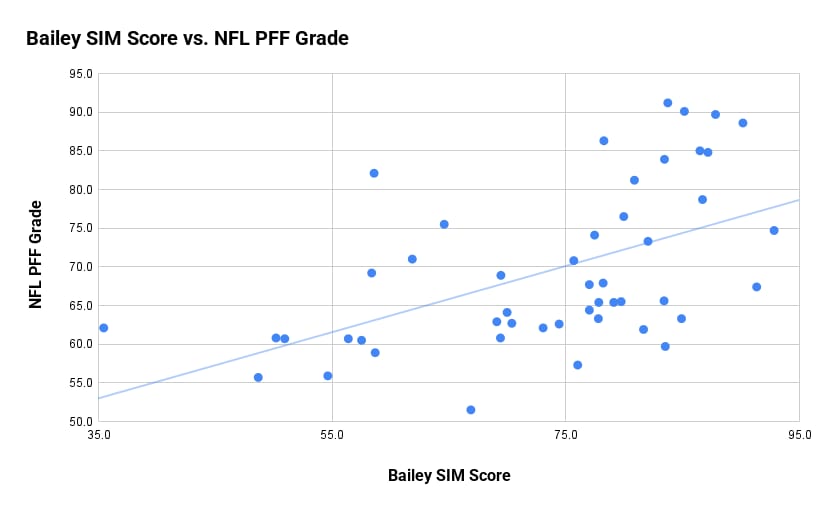
Based solely on college production (which does not tell the whole story!), Bailey appears to have the best chance of becoming an NFL star of any EDGE prospect in this draft.
Romello Height, Texas Tech
- Chop Robinson (NFL PFF grade: 63.3)
- Aidan Hutchinson (88.6)
- Myles Garrett (90.1)
- Joey Bosa (83.9)
- Marcus Davenport (74.7)
- Correlation Coefficient between Height SIM score and NFL PFF grade: 0.368
We’ve seen some enticing signs for the Texas Tech product. The main concern with Height is that he played for four schools and will be 25 years old by draft weekend, but you cannot question his dominance in critical facets of the position.
Rueben Bain, Miami (FL)
- Joey Bosa (NFL PFF grade: 83.9)
- Chop Robinson (63.3)
- Myles Garrett (90.1)
- Aidan Hutchinson (88.6)
- Kwity Paye (67.7)
- Correlation Coefficient between Bain SIM score and NFL PFF grade: 0.307
This is a boom-or-bust top-five, but the ceiling is evident. Overall, there is a decent correlation here, suggesting that prospects tend to perform better the more similar they are to Bain’s profile.
Akheem Mesidor, Miami (FL)
- Joey Bosa (NFL PFF grade: 83.9)
- Myles Garrett (90.1)
- Chop Robinson (63.3)
- Bradley Chubb (67.9)
- Aidan Hutchinson (88.6)
- Correlation Coefficient between Mesidor SIM score and NFL PFF grade: 0.268
Like Height, Mesidor will be 25 by draft weekend, which is certainly a knock on his profile. An age advantage can help a prospect dominate in college against opponents who are less physically developed.
Nonetheless, you have to love the production, and if we’ve learned anything throughout these two gigantic articles in which I ramble on and on about nerdy stats, it’s that elite-level college production is a great sign for EDGE prospects.
If you’re going to bet on anything with an edge rusher, bet on what he’s shown, not what he might show.
Arvell Reese, Ohio State
- Gregory Rousseau (NFL PFF grade: 82.1)
- Lukas Van Ness (62.7)
- Haason Reddick (64.4)
- Tyree Wilson (57.3)
- Dallas Turner (65.6)
- Correlation Coefficient between Reese SIM score and NFL PFF grade: -0.105
This isn’t promising. Rousseau is the only player in Reese’s top five who has been an above-average overall player throughout his NFL career.
Altogether, there is almost no correlation between Reese’s SIM score and NFL PFF grade. In fact, there is a tiny negative lean, indicating a slight tendency for players to perform better the less similar they were to Reese across these four metrics.
The biggest red flag for Reese is that nearly all of the league’s most successful first-round edge rushers had a much more proven track record when it came to overall PFF grade and pass-rush win rate.
Of the 10 players in the 48-man sample with an 80.0+ career PFF grade in the NFL, nine of them had at least an 80.0 PFF grade and a 16% pass-rush win rate in their final college season; Reese hit neither benchmark. The lone exception in that 10-man group was Rousseau, which explains why he rated out as Reese’s closest comparison.
Evaluating Reese from a statistical perspective is a unique endeavor since he essentially played a different position than most of the players we are comparing him to. However, it did not stop other off-ball-heavy prospects, like Micah Parsons and Josh Hines-Allen, from thriving in the same predictive metrics where Reese fell short.
The film junkies will go to bat for Reese, and they have excellent points. The man is a monster on tape. And, ultimately, we should always blend the film and the analytics. Neither side can tell the whole story. Reese’s underwhelming numbers in certain categories should not deter the Jets, or any other team, from selecting him early in the draft if they love what they see on film.
The numbers have made their case, though: Bailey and Bain offer more appealing profiles for the second overall pick. Is there enough on film for the Jets to overrule these projections and pick Reese regardless?
