
It’s the woe-is-Jets story that writes itself.
New York endured another miserable season—historically miserable, in fact. Aaron Glenn became the first Jets coach in history to start a season 0-7. His team became the first in league history to finish a year with zero interceptions, while it set the all-time record for the worst point differential in December (-107).
With that type of ineptitude, the team surely will be rewarded with the first overall pick and an elite quarterback prospect, right?
Wrong. The Jets scraped out three wins on the strength of a dominant special teams unit, causing them to slip to the second overall pick. This will cost them the right to draft Heisman Trophy winner and CFP national champion Fernando Mendoza.
But there is definitely a second quarterback they could take, right?
Well, not assuredly. Some will vouch for Alabama’s Ty Simpson as worthy of the second overall pick, but he is no slam-dunk in that draft slot. And now that Oregon’s Dante Moore is headed back to school, the Jets are pretty much down to either reaching for Simpson or punting their pursuit of a franchise-caliber quarterback prospect to 2027.
The Jets have been victimized by these types of stories many times. Whether it was Peyton Manning spurning New York in 1997 or the listless 2020 team squandering the rights to Trevor Lawrence, Jets fans are used to their perpetually quarterback-starved franchise finding new ways to barely miss out on blue-chip signal-callers.
Thus, it is understandable why the prevailing narrative in the national media right now is that the Jets have fallen victim to another quarterback tragedy. They bungled the chance to draft the only franchise quarterback prospect in this draft, Mendoza, and now, they will spend the decade watching jealously from afar as he tears it up in Las Vegas.
At least, that is the classic woe-is-Jets tale that the talking heads want you to believe.
Is it reality, though?
Monday night’s CFP title game raised serious questions about whether Jets fans should really be all that distraught about their team (potentially) missing out on the chance to draft Fernando Mendoza.
Is Fernando Mendoza all he’s cracked up to be?
Make no mistake: Mendoza had one of the most memorable college football seasons in history, and he is an excellent NFL prospect.
He’s smart, a stellar leader, insanely accurate in the short part of the field (a critical skill in today’s league), and has the ideal build. Nothing in this article is intended to suggest that Mendoza does not have a chance to succeed in the league, or that he is not worthy of being a first-round pick.
But is he the type of generational, franchise-altering prospect that a team like the Jets should lose sleep over missing out on?
Let’s be honest: At Indiana, Mendoza had about as pristine a supporting cast around him as a quarterback could possibly ask for.
From Curt Cignetti’s masterful play-calling, to near-perfect pass-catchers, to a dominant run game, to an excellent offensive line, Mendoza had one of the easiest jobs of any potential first-round prospect that we’ve seen in recent memory.
There are numbers to back it up.
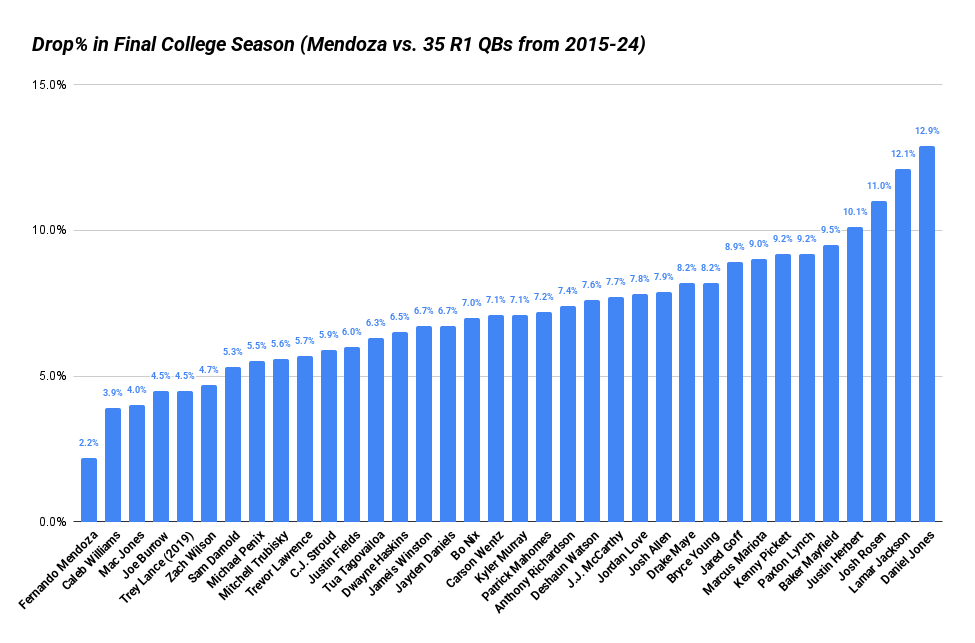
In the 2025 season, Mendoza had only six passes dropped. Stacked against his 273 completions, Mendoza suffered from a drop rate of just 2.2% on his catchable balls.
That is far lower than the rate of any first-round quarterback drafted from 2015-24 in their final college season; the lowest mark among that 35-man group is 3.9% (Caleb Williams’ 2023 season at USC). The average among those 35 quarterbacks was 7.2%, a rate that is more than triple Mendoza’s.
Toss in a rushing attack that averaged over 207 yards per game (fourth among Power Four teams), a left tackle in Carter Smith who had the second-best PFF pass-blocking grade among Power Four left tackles (90.0), and the hefty number of wide-open throws cooked up for him by Cignetti’s RPO-heavy system, and Bloomington was essentially quarterback heaven.
The impeccable system around Mendoza makes it difficult to deduce whether he projects as a game-changing quarterback in the NFL. Is he the type of talent who can step into a sputtering franchise like Las Vegas or New York and be the reason they turn things around? Or is he only capable of leading a team to success if everything around him is clicking?
There are legitimate reasons to believe that Mendoza was propped up by his surroundings and will be exposed at the pro level once he is asked to carry a team rather than vice versa. The CFP title game brought those concerns to the forefront.
Jets X-Factor’s Robby Sabo dissected it in a recent breakdown: Mendoza is outstanding when he is playing “on-schedule” in Cignetti’s expertly designed offense, but when the going gets tough, Mendoza runs into problems. We saw these issues on display at Hard Rock Stadium, where Mendoza, for once, did not enjoy the luxury of playing in a utopian envrionment.
Potential second-overall pick Rueben Bain Jr. and the Hurricanes’ defense did not allow Mendoza to breathe. He was pressured on 10 of his 31 dropbacks (32.3%), slightly above his season-average pressure rate of 29.8%, and that’s despite Mendoza averaging a season-low 2.25 seconds to throw, well below his 2.67 season average.
Simply put, Mendoza was under constant duress. And he struggled to respond. Across his 10 pressured dropbacks, Mendoza netted just 9 yards. He completed 3-of-6 passes for 31 yards, took three sacks for a loss of 23 yards, and scrambled once for one yard.
Even when Mendoza did find success against Miami’s defense, it often had more to do with his incredible pass-catching support than any type of pristine passing. Two of Mendoza’s longest completions of the night were back-shoulder throws to Charlie Becker, where the ball was certainly not placed where Mendoza wanted it, but Becker bailed him out with incredible catches. Both passes were from completely uncontested pockets, too.
Becker had zero drops the entire season, speaking to the type of help that Mendoza received to prop up his production.
Becker also nearly turned a routine field-side quick-out into a touchdown through his YAC skills.
That play speaks to yet another major benefit that Mendoza profited from throughout the year: His receivers were outstanding after the catch. Indiana’s receivers forced 68 missed tackles after the catch, ranking as the sixth-most among Power Four teams.
They didn’t drop passes, they generated extra yards by making defenders miss, they had a stalwart blindside protector, they had a brilliant offensive coach, and they ran for over 200 yards per game; what more could Mendoza have possibly had?
Again, this isn’t to say that Mendoza is not a good quarterback. He did his part to make sure all of these benefits were maximized. Not every quarterback would have achieved the same level of success in the same situation.
But when you’re projecting a college quarterback to the NFL, what you’re trying to find out is how he will handle a significant uptick in competition and expectations. It does not matter how productive a quarterback was in college. What matters are the tendencies and habits that he displayed; those are things that will be built upon by NFL coaching.
And in those areas, Mendoza is lacking—at least relative to what you would hope to see from a quarterback projected to go first overall.
Two of the best metrics for predicting the NFL success of first-round quarterback prospects are deep pass attempt rate and turnover-worthy throws. The more of each that a quarterback has in his final college season, the likelier it is that he succeeds in the NFL.
It speaks to the value of a few things when it comes to projecting college quarterbacks to the NFL:
- There is value to coming from an NFL-esque college environment, as it better prepares the prospect for the harsh realities of the pro game. More deep passes and more turnover-worthy throws indicate a likely combination of two things:
- the prospect likely came from a more NFL-esque scheme that did not overly rely on schemed-up RPOs and screens.
- the prospect may have played with less-than-ideal protection and receivers, which is a positive for the prospect’s long-term development even if it leads to poor short-term results in college.
- The inherent confidence displayed by frequently attempting downfield throws and dangerous tight-window throws is a green flag from a development standpoint, regardless of whether those throws are completed or if they are considered reckless at the time.
In these two areas—deep pass attempt rate and turnover-worthy throw rate—Mendoza’s numbers compare unfavorably to the most successful first-round quarterbacks of the past decade-plus. He did not hit the ideal threshold in either category, yielding a relatively low probability of NFL success, at least based on the eventual NFL performance of first-round prospects with similar numbers to Mendoza in these predictive metrics.
It all circles back to the support that Mendoza received, and the question of whether he is limited to being a “bus driver” in the NFL (as Charles Barkley might say), or if he has the talent to single-handedly turn a franchise around, which is what a team should expect when picking a quarterback first overall.
Jets fans shouldn’t lose sleep
Mendoza is no slouch, but compared to the typical standards of quarterbacks picked first overall, he seems like a bit of a reach. The Raiders would be taking a massive gamble that Mendoza, who did not receive first-round hype until he stepped into a juggernaut of a program at Indiana, can be a game-changing NFL quarterback in an environment that is guaranteed to be nowhere near as quarterback-friendly as the one he came from.
Even if Mendoza were drafted to, say, the Chiefs or the Lions, the environment would still be nowhere close to as favorable as it was at Indiana. The Hoosiers’ roster was littered with older players. At every position on the field, Indiana was more experienced, more talented, and physically stronger than the other team.
That extended to the head coaching position, where Cignetti handed things to Mendoza on a silver platter with regularity. No NFL coach will have as sizable an advantage over his opponent as Cignetti did over most of his opponents. The guy is a genius, and that cannot be overstated in the evaluation of Mendoza.
In the NFL, the talent gap is immensely smaller than it is in college. To become a star quarterback in a league where everyone is a premier athlete with all-world skills, Mendoza has to be a premier talent. Based on what we saw at Indiana, we cannot say with certainty that he is one. His job was simply too easy for anyone to claim that they know how talented Mendoza truly is.
You just can’t get much value out of Mendoza’s tape when it comes to NFL projection. He looked damn good for a college quarterback, but not much of what he did is transferable to the pros.
Having said that, he is still very much capable of becoming an MVP. He also might be a bust. The fact of the matter is, both options are equally in play, and for a No. 1 pick, those are not the odds you’re looking for.
While nothing is ever guaranteed in the NFL draft, the first overall pick should ideally be someone who has displayed enough clear-cut franchise-lifting talent to suggest they lean heavily toward a superstar projection, and that is not the case for Mendoza.
The Jets will have plenty of chances over the years to find more Mendozas. They might not have that chance this year, though, which means the loss of the first overall pick surely hurts if the goal is to find any quarterback with any semblance of starter-caliber potential in 2026.
But if Jets fans are holding out hope for a truly “generational” talent, someone with a high chance of panning out as at least a starter, and an obvious MVP ceiling, they have nothing to lose sleep over.
Not yet.
