
Things had to change.
The New York Jets’ 3-14 season in 2025 was worse than the three wins let on. With no interceptions, 36 passing touchdowns allowed, four takeaways, 23 turnovers, 15 passing touchdowns, and a -203 point differential, the Jets established themselves as one of the worst teams in NFL history.
Changes were inevitable.
When Woody Johnson elected not to make head coach Aaron Glenn one of those changes, it fell on Glenn to decide who should be held accountable for the historically inept effort.
Glenn got a head start in December when he fired defensive coordinator Steve Wilks before the season concluded. That move made sense; Wilks’ play-calling was incredibly predictable, and players were regressing under his watch.
About a month later, Glenn added some more assistant coaches to the list of names who were let go. Names such as quarterbacks coach Charles London and linebackers coach Aaron Curry were unsurprising. However, it was a mild shock to see Glenn go so far as to dump seven additional coaches, most of them on defense, along with a key offensive name, pass game coordinator Scott Turner.
Things were already trending in a murky direction when Glenn purged a massive chunk of the staff that he himself had built, with Turner quickly taking to social media to say he “hates” the Jets. But fine; perhaps it could be argued that Glenn was holding people accountable, admitting his mistakes, and looking to right his wrongs.
With his latest move, though, Glenn’s coaching purge has officially gone overboard.
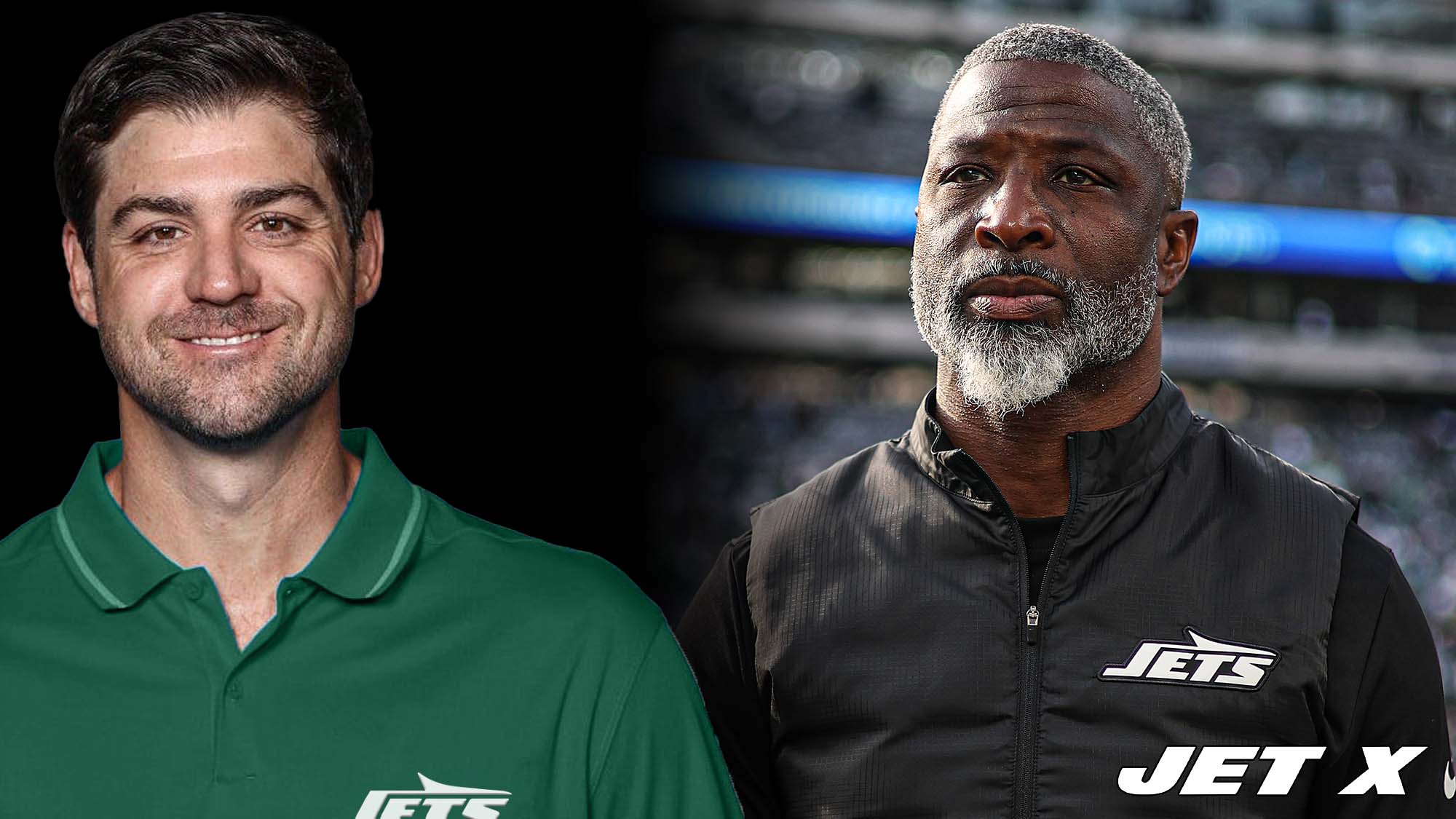
Parting ways with offensive coordinator Tanner Engstrand makes little to no sense and proves that Glenn ultimately has not had a concrete plan from the day he was hired as the Jets’ coach.
What did Engstrand do to deserve this?
It would be a stretch to claim that Engstrand was a “good” offensive coordinator for the Jets in 2025.
However, for a first-year play-caller who had to work through horrendous play at quarterback and wide receiver, he showed some intriguing potential that was worth building upon.
Anyone who watched the Jets’ All-22 film throughout the 2025 season (the brave few) could tell you that Engstrand was scheming receivers open all year, only for them to be missed by some combination of inaccuracy, drops, or quarterbacks holding onto the ball too long.
The numbers back up the idea that Engstrand was doing a pretty good job of scheming people open. In multiple categories, he put up the type of numbers that you typically see from top-tier offensive minds.
For instance, the Jets ranked fourth-best in the NFL with 2.9 average yards of separation on intermediate targets, per NFL Pro. They trailed only the Bills, Bears, and Seahawks, a trio of teams led by Joe Brady (who is now the Bills’ head coach), Ben Johnson (whom Engstrand worked under in Detroit), and the ascending Klint Kubiak.
New York also ranked eighth-best in the NFL with a wide-open target rate of 10.7%, per FTN Fantasy. They were one spot ahead of Mike McDaniel’s Dolphins, two spots ahead of the Lions, and three spots ahead of Johnson’s Bears.
These are the types of names you want to see your OC ranked alongside.
Despite all of this, the Jets ranked last in passing yards and 31st in pass offense DVOA.
Why? Well… the players were squandering Engstrand’s separation. You saw it in the clips above, and the numbers back that up, too. New York ranked 29th in completion percentage on pass attempts with three-plus yards of separation (82.3%) and 30th in drop rate (8.5%).
The picture could not be clearer that Engstrand was a promising young OC hung out to dry by poor talent. While it would be excessive to claim that Engstrand is a hidden genius who is guaranteed to be the next Sean McVay, he had obviously done enough to warrant a second year with better talent on the roster.
After all, the Jets’ 2025 season was about laying a foundation, right? In December, Glenn claimed that the Jets “had a plan” and asked fans not to “let go of the rope.” All of the blowout losses and record-breaking stats were for the grander purpose of building for the long haul.
One would think that a thoroughly executed long-term plan would involve sticking with the few people who helped lay workable building blocks in the beginning. Engstrand was one of those people. If the Jets really had a plan from the start, Engstrand would have been part of it, and he did nothing in 2025 to suggest he no longer deserved to be included.
Firing Engstrand is the latest and most definitive proof that Glenn does not, in fact, have a plan—and he probably never did.
At this point, we’re looking at the captain of a ship who has tossed his entire crew overboard to shed weight as he navigates a deadly storm, even though it was the captain who led them into it.
It is true that multiple coaches needed to be held accountable after the Jets’ 2025 disaster. If Glenn was going to stay, he could not justify doing nothing with his staff. He correctly parted ways with coaches like Wilks, London, and Curry. In a vacuum, Glenn firing a plethora of coaches is not a bad thing.
But Engstrand may have been the only coach on the Jets’ offensive or defensive staff who provided legitimate reasons to believe he could be part of the long-term solution. If Glenn truly viewed the 2025 season as the start of a concrete plan he had laid out from the beginning, he would have stuck with Engstrand and seen the plan through.
By dumping Engstrand, Glenn has proven that he is basically winging it at this point. He is a lame-duck, under-pressure head coach who knows he will be fired in 2026 if he loses a couple of games to start the year, so he is desperately scrambling around and flipping random switches on the Millenium Falcon as it gets pulled in by the Death Star’s tractor beam, hoping that one of them is a magic light-speed button that immediately flies him out of the Empire’s grasp and into playoff contention.
Except in this movie, there probably won’t be a heroic escape… even if Glenn thinks Frank Reich can be his Obi-Wan.
