
Darren Mougey is only one year into his career as an NFL general manager.
Right now, it’s too early to say much about what Mougey thrives or struggles with in the GM chair, especially since he oversees a rebuilding team that went 3-14 in his first season.
We can say one thing with confidence, though: The man knows how to trade for defensive tackles.
Mougey’s late-summer 2025 deals for Jowon Briggs and Harrison Phillips provided New York with two of their few useful pieces on the defensive side of the ball. Those acquisitions were praised for their value when they were announced, and they aged like wine as the season progressed.
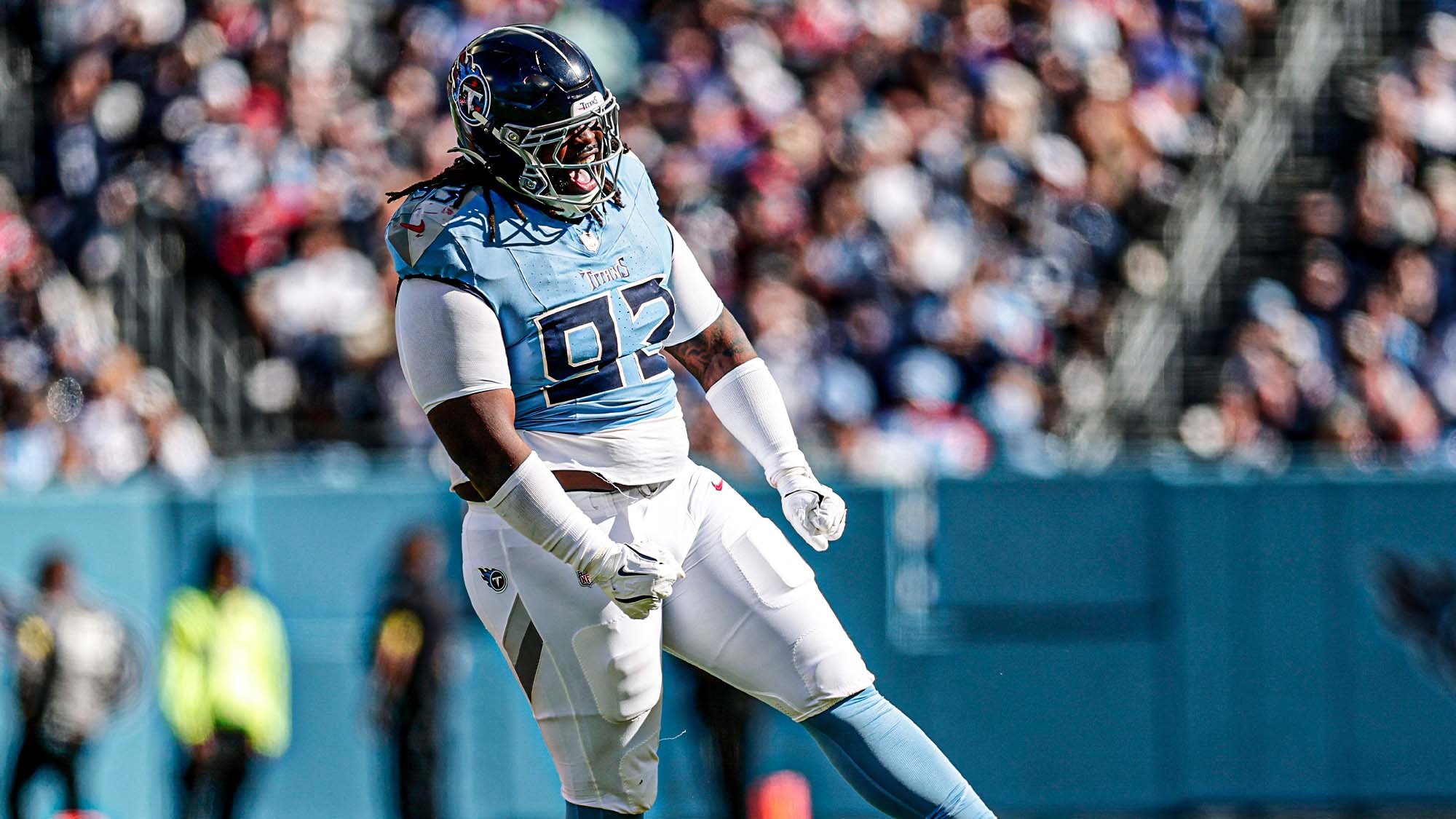
Fast forward to February 2026, and Mougey has swung another critically acclaimed deal for an interior defensive lineman, sending Jermaine Johnson to Tennessee in exchange for T’Vondre Sweat.
It leaves the Jets with a dynamic young duo on the interior of their defensive line moving forward: T’Vondre Sweat and Jowon Briggs.
Jets’ new core DT duo
Before the Sweat trade, there was only one offensive or defensive position group on the Jets’ roster that boasted multiple quality building blocks: the offensive line.
A handful of solid players at other positions were speckled throughout New York’s depth chart, but the O-line was the only position group where the Jets could feel confident about the long-term direction of the unit as a whole.
Now, they can add the interior defensive line to that list.
In Jowon Briggs and T’Vondre Sweat, New York has two soon-to-be 25-year-old defensive tackles who yielded outstanding production in the 2025 season. Given their age, proven floors as above-average starters, and ascending trajectories, this duo has the potential to anchor the Jets’ defensive line for many years to come.
Briggs was acquired by Mougey in late August to be a rotational run stuffer, but he blew those expectations out of the water. Taking advantage of a snap-count boost following the Quinnen Williams trade, Briggs established himself as a star-caliber interior pass rusher.
The former Browns seventh-round pick finished the 2025 season with 38 total pressures on 320 pass-rush snaps. His 11.9% pressure rate was seventh-best among the 97 defensive tackles with at least 200 pass-rush snaps. To boot, his 85.6 pass-rush grade from Pro Football Focus ranked fourth, while his 15.7% pass-rush win rate was third.
The only defensive tackles with a better pass-rush win rate than Briggs in 2025 were Chris Jones and Jeffery Simmons.
And remember, this is coming for a guy who was already respected for his run defense. While doing exceptional work in the pass game, Briggs still managed to tie for 28th among defensive tackles with 19 run stops, all while missing just two tackles.
Sweat, meanwhile, comes to New York with an elite track record as a run defender. In 2025, he earned a 79.3 run defense grade from PFF, placing fourth-best among defensive tackles (min. 150 run defense snaps). Only Travis Jones, Cameron Heyward, and Quinnen Williams fared better.
Like Briggs, Sweat’s dominance in one phase is complemented by solid play in the other. The 366-pounder is not just a space-eater in the run game; he can go get the quarterback, too.
This past season, Sweat placed 16th in PFF’s pass-rush grade (74.1), 36th in pressure rate (9%), and 40th in pass-rush win rate (9.4%) among 97 qualified defensive tackles (min. 200 pass-rush snaps). He’s a bona fide above-average interior pass rusher.
It’s the pass rushing that puts Sweat over the top as a dangerous all-around player for offenses to deal with.
Plenty of mammoth DTs around the NFL can clog up the run game, but many of them become non-factors if they get caught on the field for a pass play. It means they add little to no value on somewhere around half of their snaps, with those snaps being the more valuable ones in terms of impact on winning (pass plays are more valuable than run plays).
Even elite run defense for 50% of a player’s snaps can be washed out if the player provides zero pass-rush impact on the other 50%. That dilemma does not exist with Sweat.
The Texas product can always be trusted to make a positive impact. Even if the opponent throws a first-down or short-yardage change-up to try and exploit the defense for having a run-stopping package on the field, Sweat is still a threat to cause havoc. It makes him a player who can be deployed in any situation.
The same goes for Briggs. While he has proven more in New York as a pass rusher than a run defender, he was already known as a run stuffer before coming to the Jets, so he is no slouch in that phase. He can pursue the quarterback at a high level and also be trusted to remain on the field for early-down or short-yardage plays.
Long-term outlook
Briggs is an exclusive rights free agent, which means the Jets will at the very least keep him on the one-year ERFA tender for the league minimum salary.
However, it would be proactive for the Jets to extend Briggs as soon as possible before his value explodes. Tendering Briggs would allow him to become an unrestricted free agent in 2027, and if he performs as well as the Jets hope in 2026, he will command an enormous contract on the open market.
New York’s best move is arguably to extend Briggs now, as he remains somewhat of an unknown commodity. This would give the Jets a massive discount while preventing him from negotiating elsewhere. It’s a minor risk given the one-year production sample, but it’s a risk worth taking for a ceiling as high as the one Briggs showed.
Briggs would be likely to accept an immediate extension for less money than what he might gain if he bet on himself for a year. Given the extremely unreliable nature of his contract situation and NFL future as a former seventh-round pick with one year of high-level production, Briggs couldn’t pass it up if the Jets came to him today with a multi-year extension in the neighborhood of $10-12 million per year.
Sweat is still under contract for two more seasons on his second-round rookie contract, carrying cap hits of just $1.7 million and $2.1 million in 2026 and 2027, respectively. An extension for Sweat could be considered in 2027.
Locking up this duo for the long haul, starting with Briggs this year, would be a prudent move for the Jets. It’s rare enough to find one young defensive tackle who can disrupt plays in both phases, let alone two. This is the type of duo that can anchor a defense for many years.
