
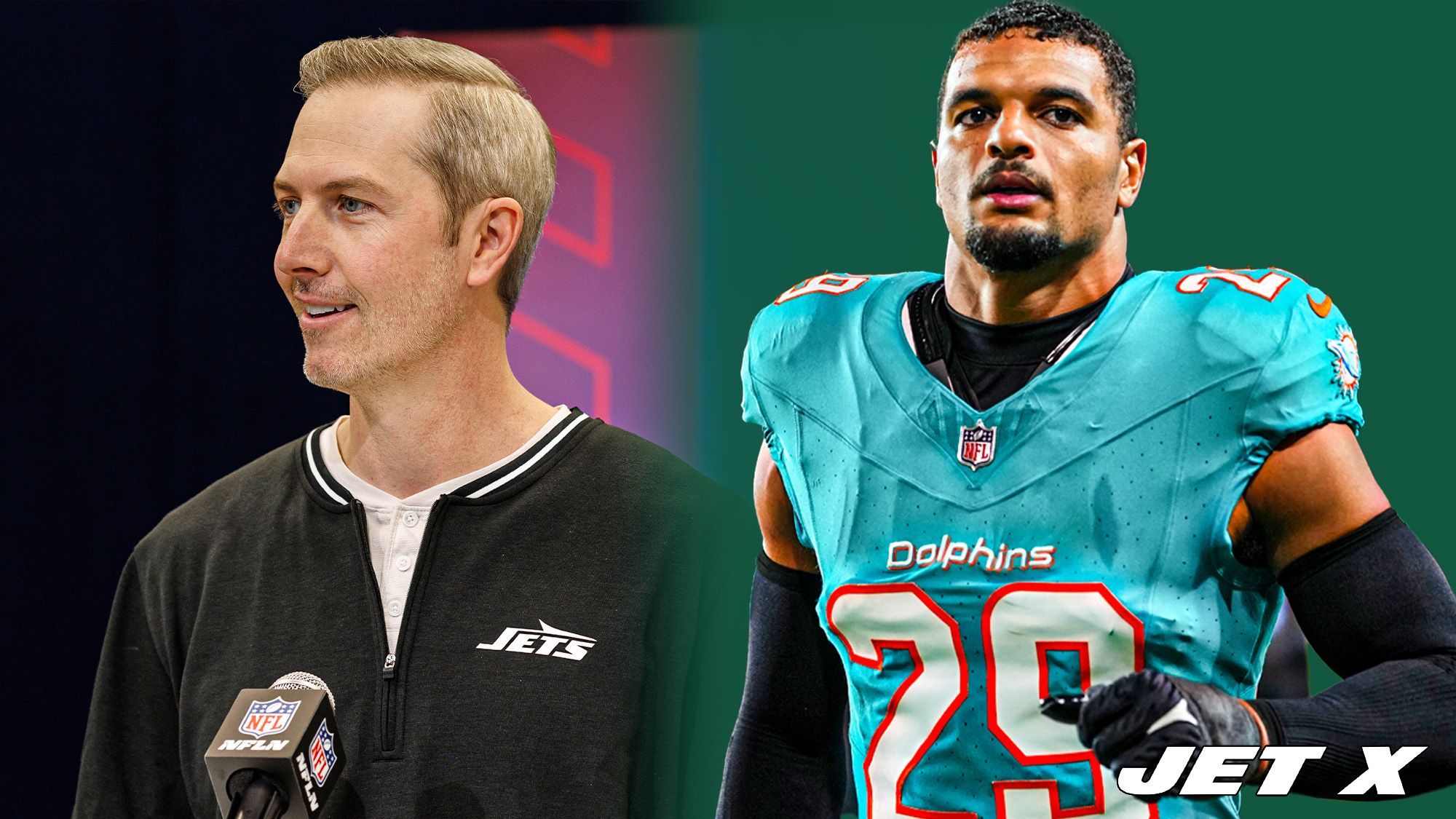
The New York Jets made a flurry of moves on the first day of NFL free agency.
Aside from agreeing to terms with five free agents, the team made a stellar trade before the legal tampering even opened, sending a seventh-round pick to the Miami Dolphins in exchange for three-time All-Pro safety Minkah Fitzpatrick.
General manager Darren Mougey continued to do what he does best: find excellent value on the trade market.
The Minkah Fitzpatrick trade was a stellar deal for the Jets
Fitzpatrick, 29, was selected by the Miami Dolphins with the 11th overall pick in the 2018 NFL draft and has blossomed into one of the league’s top safeties throughout his career.
While playing for the Miami Dolphins and the Pittsburgh Steelers, Fitzpatrick has compiled five Pro Bowl seasons and has been named a first-team All-Pro three times.
Over his eight-year career at the NFL level, Fitzpatrick has played in 120 games (115 starts), posting 60 passes defended, 21 interceptions, 690 total tackles (459 solo), seven fumble recoveries, and six forced fumbles.
Returning to the Dolphins in 2025, the Alabama product appeared in 14 games (all starts), and he collected 92 total tackles (59 combo), an interception, six pass deflections, two fumble recoveries, and a forced fumble.
While the Jets acquired Fitzpatrick for next to nothing in a seventh-round pick, they gave him a nice extension. New York signed the five-time Pro Bowler to a three-year, $40 million deal, which comes to about $13.3 million per season.
According to Over the Cap, the deal currently ranks just 14th among NFL safeties in average annual value — and it likely won’t stay there for long as more free-agent contracts come in.
For a player of Fitzpatrick’s caliber, though, the extension is far from an overpay.
While he is entering his age-30 season, the Old Bridge, N.J., native remains one of the league’s top safeties.
According to Pro Football Focus, his fantastic 81.8 defensive grade ranked seventh among 98 qualified safeties, while his coverage grade of 78.3 ranked ninth.
When looking at all of these metrics, I know what you are thinking… “Connor, why would the Dolphins trade this player to a division rival for next to nothing?”
Well, here’s why.
Why did the Dolphins part ways with Minkah Fitzpatrick?
There are a lot of moving pieces in Miami. The Fitzpatrick trade is just the latest move in a mass exodus of the Dolphins’ former building blocks.
This offseason, Miami underwent a full regime change, hiring a new general manager (Jon-Eric Sullivan) and head coach (Jeff Hafley). They also pivoted at quarterback, releasing Tua Tagovailoa and starting fresh with Malik Willis.
Entering free agency, the Dolphins had under $5 million in cap room, among the lowest in the league, and they needed to free up extra money.
Trading Fitzpatrick provided some cap relief, as their commitment to the safety drops from $18.8 million to $12.9 million for the 2026 season, creating around $6 million more in cap space.
However, the trade remains largely nonsensical for Miami.
While they created extra cap space, Fitzpatrick was a valuable chess piece for the Dolphins’ defense last season, playing all over the secondary as injuries caused him to move around. He remained an elite player at 29 years old.
Trading Fitzpatrick provides Miami with slightly more money to spend, but the Dolphins now have to fill the significant void left in the secondary by Fitzpatrick’s departure, while receiving negligible draft capital in return.
Overall, it’s another heist for Darren Mougey and the New York Jets. They snatched a star player on the cheap by taking advantage of a division rival in fire-sale mode.
