
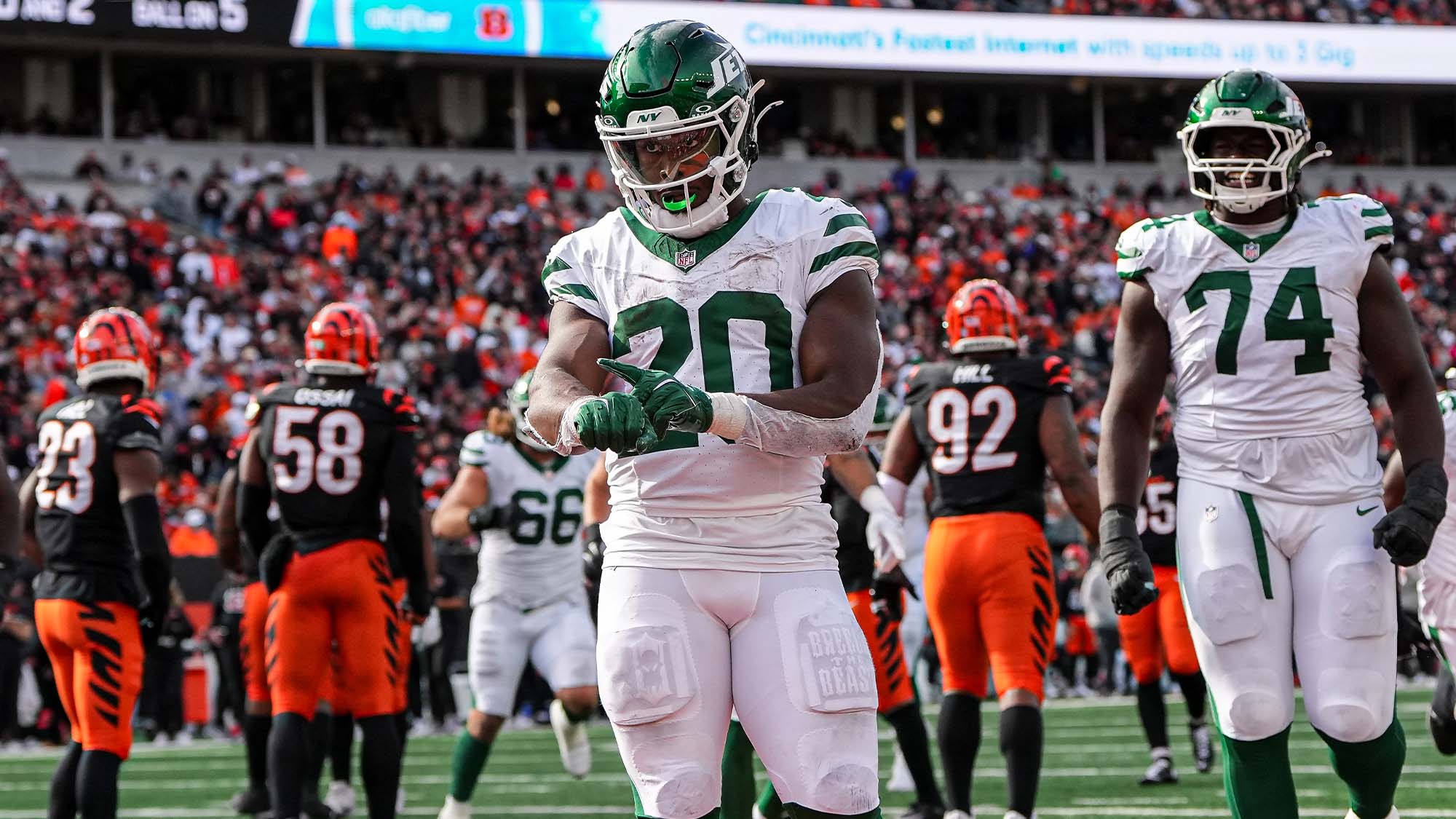
On Tuesday, we analyzed Breece Hall’s potential to climb the New York Jets’ all-time rushing list.
The good news for Hall, who currently ranks 12th with 3,398 rushing yards, is that he has a pathway to climb very high, very quickly. With just 888 rushing yards in 2026, he will be fourth on the team’s all-time rushing list at the end of the season.
Hall only needs 1,738 rushing yards to reach third place, which he is on pace to do by the end of the 2027 season.
But if Hall wants to surpass second-place Freeman McNeil (8,074) or top-ranked Curtis Martin (10,302), he has an extremely long way to go. Hall would have to maintain his current production well into his 30s, or spike his production to career-high levels and maintain it into his late-20s/early-30s.
Realistically speaking, the No. 3 slot is Hall’s likeliest destination on the Jets’ all-time rushing list. While he is certainly talented enough to push higher, he still has miles to go; he isn’t halfway to McNeil’s total or a third of the way to Martin’s total.
There is another list, though, where Hall has a much stronger chance of finishing his career as the Jets’ No. 1 all-time player.
The all-time Jets list that Breece Hall could top
Hall didn’t earn the third-highest salary among NFL running backs solely because of his rushing impact. His receiving ability is what puts him over the top as a game-changing running back who deserves that type of money.
Hall’s career average of 60.7 rushing yards per game doesn’t blow anyone away, but his 29.3 receiving yards per game are a very high mark for a running back. Combined, he has averaged 90 scrimmage yards per game in his career.
Now that is the type of number that will turn some heads. It’s also a much more unique number in Jets history than Hall’s pure rushing production.
Hall is currently 14th on the Jets’ all-time scrimmage yards list (5,040). While it’s two spots lower than his rushing ranking, he is on track to reach the No. 1 slot much faster.
Curtis Martin ranks No. 1 in this category as well, with 12,741 yards. That gives him a 7,701-yard advantage over Hall.
At his current average of 90 scrimmage yards per game, Hall would need 86 games to pass Martin. With perfect health, he would get there in the season opener of a sixth season from now (2031), at which point he would be 30 years old.
That would be difficult, but it seems doable—much more so than catching Martin in rushing yards.
Hall trails Martin in rushing yards by 6,904. At a pace of 60.7 yards per game, Hall would need 114 games to pass Martin, which would take him deep into a seventh season from now (2032), his age-31 season.
That’s a 28-game difference in how fast Hall would break each record based on his current career averages.
Of course, Hall’s averages could change moving forward. The Jets hope they can give Hall a better environment to succeed than he’s ever had before, boosting his numbers.
However, when the upcoming season kicks off, Hall will already be 25 years old with 943 career touches. He may remain in his prime throughout his current three-year contract, but once he reaches his late-20s, it’s likely he will begin declining. Hall has to maintain his current level of play (or better) into his 30s to catch Martin on either list.
Longevity will be the key to Hall’s lasting legacy in New York. As things stand, he is easily on pace to finish as one of the top three running backs in Jets history; perhaps it can be argued that he had the highest peak.
But Martin’s consistency and longevity are what put him at the top of the Jets’ all-time rushing and scrimmage yards lists. Year after year for his first seven seasons in New York, Martin played nearly every game and easily eclipsed both 1,000 rushing yards and 1,400 scrimmage yards.
Can Hall do that? It remains to be seen, especially in terms of pure rushing production.
It’s also worth noting that Martin and Hall hail from much different eras. Back in Martin’s day, it was customary to force-feed over 20 carries per game to your lead back. Martin averaged 20.8 carries per game in his Jets career; he even had a season where he averaged nearly 25 carries per game (1998), and it still wasn’t enough to lead the league.
Hall, meanwhile, is averaging just 13.5 carries per game in his career, with a career-high of 15.2 last year. That could go up if the Jets ever become competent enough not to spend most of the season in catch-up mode, but even for good teams, it’s rare in today’s NFL to see any running back given as many carries as Martin received.
The 2025 league leader in carries per game, Jonathan Taylor, received only 19.0 carries per game. Today’s NFL teams want to keep their star running backs fresh enough to be effective in fourth quarters and last through 17 games. So, they are more willing to spread carries throughout the backfield than the teams of the late-1990s and early-2000s.
As talented as Hall is, it would be incredible if he ever passes Martin on the Jets’ all-time rushing list. The modern game isn’t conducive to him getting there while he is still in his prime, so he would need to display a degree of longevity that only Derrick Henry has shown over the past 10 years.
The scrimmage yards list, though? That’s a much more feasible goal for Hall.
When you add his receiving production into the pot, Hall is racking up yardage fast enough to potentially catch Martin within the next five years. Of course, this would require Hall signing another contract to stay in New York beyond the next three years, but if things go as well for Hall as the Jets are planning, it could ultimately be a no-brainer to make Hall a Jets lifer.
The exciting part of the equation is that Hall’s receiving potential arguably still hasn’t been fully tapped into. This past season, he was thrown a career-low 3.0 targets per game, a baffling misuse on the Jets’ part considering how little talent they had at the wide receiver position.
Yet, Hall averaged a career-best 7.3 yards per target. That was thanks largely to his career-low 2.7% drop rate, as he dropped just one pass all season. This was a major step forward for Hall, who struggled with drops over his first three seasons despite his explosiveness after the catch when he secured the ball. From 2022-24, Hall had 17 drops and a 10.1% drop rate.
The progress Hall displayed in 2025 gives him a tantalizing pass-catching ceiling moving forward if the Jets pump his volume back up. If Hall maintained his career-best 7.3 yards per target on the career-high volume of 5.6 targets per game that he received back in 2023, he would average 40.9 receiving yards per game, on pace for 695 yards over 17 games.
That would beat his previous career high in receiving yards (591) by over 100 yards.
This, of course, is all projection. Nonetheless, it shows that Hall’s best numbers could still be ahead of him. And if that’s the case, Martin’s scrimmage yards record could be put in serious jeopardy over the next half-decade.
There is an outside chance that the Jets may have just re-signed the man who will go down as the most productive all-around offensive weapon in franchise history.
