
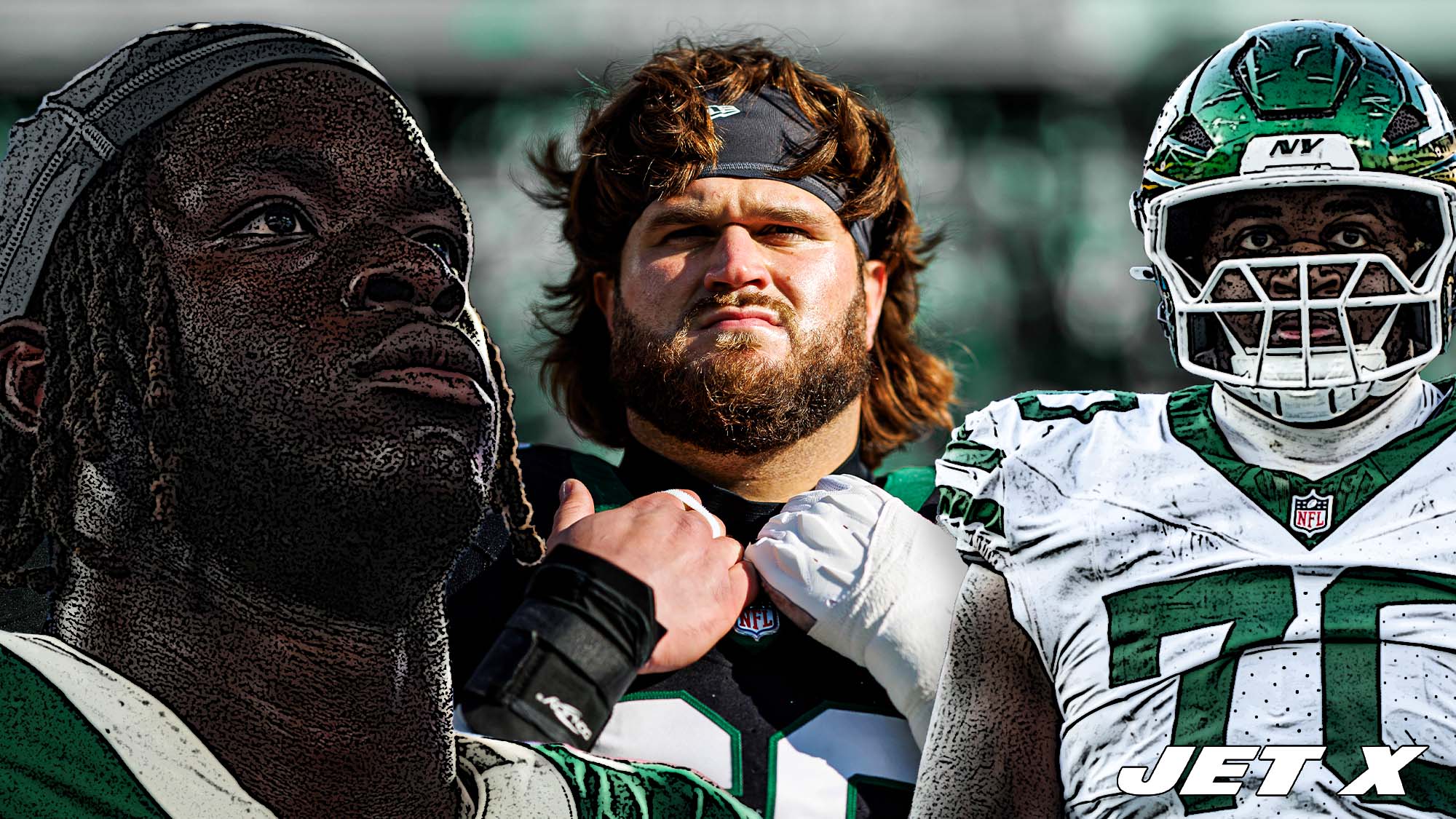
Joe Tippmann is officially set to wear green and white for the next four years, which means the New York Jets have secured each of their five projected starting offensive linemen for at least the next two years:
- LT Olu Fashanu
- LG Dylan Parham
- C Josh Myers
- RG Joe Tippmann
- RT Armand Membou
What is the ceiling of this five-man unit in 2026 and beyond?
Projecting the Jets’ 2026 offensive line ranking
One of the greatest challenges in football analysis is quantifying the performance of a team’s offensive line.
There are numerous team-wide categories that we know are influenced by the offensive line, including sacks and rushing yards, but without extensive film-watching for context, we can never definitively state how much of an impact the offensive line itself had on these metrics.
Thus, we are still left with the polarizing Pro Football Focus grading system as the only publicly available method for quantifying offensive line production in a viable fashion. PFF grades are calculated by grading each player’s individual performance on each rep through an analyst’s evaluation of the film, which makes them a better method for evaluating an offensive lineman’s true quality than certain metrics that lack context.
Of course, PFF grades must still be taken with a grain of salt, as grading a football player is a subjective process unless it is done by a coach on the team who knows the player’s assignment on each play. PFF grades are known for delivering strange conclusions at times.
For that reason, take the following analysis with a grain of salt, if you please. With that being said, it is still a fascinating exercise to use PFF grades for projecting what the ceiling of the Jets’ offensive line might be from a statistical standpoint.
How the Jets’ starting five OL rates cumulatively
Here are the overall PFF grades generated by the Jets’ five starting offensive linemen in 2025:
- LT Olu Fashanu: 69.2
- LG Dylan Parham: 63.6
- C Josh Myers: 52.9
- RG Joe Tippmann: 66.0
- RT Armand Membou: 72.7
The five players combined for an average grade of 64.9. With that mark, the Jets’ offensive line would have ranked 18th out of 32 NFL teams in terms of the cumulative overall grade produced by all offensive linemen to take a snap, slotting between the Jacksonville Jaguars and the Dallas Cowboys.
The hope, though, is that each of these players will take a step forward in 2026.
Fashanu and Membou are each first-round talents who will be making their second career Week 1 start this season. At just 23 and 22 years old, respectively, it is fair to expect both players to put up better grades in 2026, especially considering they both improved in the second half of the season.
Tippmann, too, should be expected to improve. The 2025 season was the first of his career in which he served as a full-time guard throughout the entire year. After a rough start, he was one of the league’s best guards from Week 7 onward. Still just 25 years old, his best could be in front of him.
Parham has less room for growth as a player who will be 27 this season, but there is bounce-back potential. His 63.6 grade in 2025 was a steep drop from his 74.3 grade in 2024. New York is hoping that Parham’s numbers will climb back up after moving from the Raiders’ woeful offensive line to a more solidified unit in New York.
It is possible that Parham’s numbers were dragged down by his surroundings in Las Vegas. In 2025, among the five Raiders offensive linemen who played at least 500 snaps, Parham was the lone player who ranked among the top 16 players at his position in PFF grade.
Offensive linemen work hand-in-hand with one another, so a player could easily be made out to look worse than he really is when playing next to struggling players (or vice versa if he has solid teammates). Parham’s respectable play when surrounded by liabilities suggests that his numbers are due to rise in New York.
The only player of the five who does not seem to offer much growth potential is center Josh Myers, whose presence in the starting lineup is one of the most overlooked problems with the team’s depth chart. Across five seasons as an NFL starter, Myers’ grade has gone no higher than a mediocre 60.4, and that was way back in 2022. Since then, he has logged three straight seasons below 55.0.
Myers appears to be a weak link that the Jets will have to live with until they can look for an upgrade next offseason, unless an opportunity arises on the veteran market over the next few months. However, the other four players each seem to be trending up.
Let’s say that all four of Fashanu, Parham, Tippmann, and Membou improve in 2026. Fashanu and Membou are the youngest and most talented of the bunch, so we’ll give them 10-point boosts, while Parham and Tippmann get 5-point boosts. These are arbitrary numbers, but they can help paint a digestible picture for the sake of this exercise.
That would leave New York’s offensive line with the following grades (assuming Myers’ mark does not change):
- LT Olu Fashanu (+10): 79.2
- LG Dylan Parham (+5): 68.6
- C Josh Myers (-): 52.9
- RG Joe Tippmann (+5): 71.0
- RT Armand Membou (+10): 82.7
Now, the unit combines for an average grade of 70.9. This would have ranked 7th among NFL offensive lines in 2025, slotting between the Atlanta Falcons and the Philadelphia Eagles:
- 1. Denver Broncos (76.3)
- 2. Los Angeles Rams (75.2)
- 3. Indianapolis Colts (74.7)
- 4. Chicago Bears (73.9)
- 5. San Francisco 49ers (73.8)
- 6. Atlanta Falcons (73.0)
- Projected: New York Jets (70.9)
- 7. Philadelphia Eagles (70.7)
- 8. Carolina Panthers (70.4)
To be clear, these 2025 team grades include all offensive linemen to take reps, not just starters, which means the Jets’ projected grade is actually a ceiling for the scenario in which all five starters play all 17 games. The Jets pulled that off last year, but it likely won’t happen again, which means the unit’s realistic ceiling (accounting for injuries) is probably a bit lower, once you account for backups coming in and playing worse than the starters.
Another way of re-contextualizing this analysis is to weigh it by positional value. The Jets are being dragged down by Myers, but center is the least valuable position in the unit. How would they fare if we accounted for this?
I re-ran the numbers with guards being valued 1.5 times higher than centers and tackles being valued 2 times higher than centers. Here are the results:
- 1. Denver Broncos (80.7)
- 2. Los Angeles Rams (78.7)
- 3. San Francisco 49ers (78.4)
- 4. Indianapolis Colts (77.0)
- 5. Chicago Bears (76.4)
- Projected: New York Jets (76.2)
- 6. Philadelphia Eagles (75.6)
- 7. Carolina Panthers (75.5)
- 8. Atlanta Falcons (74.7)
In this scenario, the Jets’ ceiling would rise to 6th. If we remove the expected improvements and stick with 2025 grades, their floor would rise from 18th to 15th.
It appears that the Jets’ offensive line has a range of outcomes from about league-average to top six. For them to hit that ceiling, they need major leaps from their young tackles and at least decent jumps from their guards. Any sort of improvement from Myers would be gravy.
Looking to the future, if the Jets want to push their ceiling from top six to potentially competing for the No. 1 spot, they need to find a new center. Myers is the weak link holding their ceiling back.
Still, if the Jets manage to have a top-six offensive line in 2026, the team is likely to have its most successful season in quite a long time. Among the top six teams of 2025 in terms of cumulative position-weighted offensive line grading (the final list above), five had at least 10 wins, and all six had at least eight wins. The Jets have not won eight games since 2015.
Nothing raises a football team’s floor quite like a strong offensive line. The Jets will have one if offensive line coach Steve Heiden can ensure each player trends toward their ceiling.
