
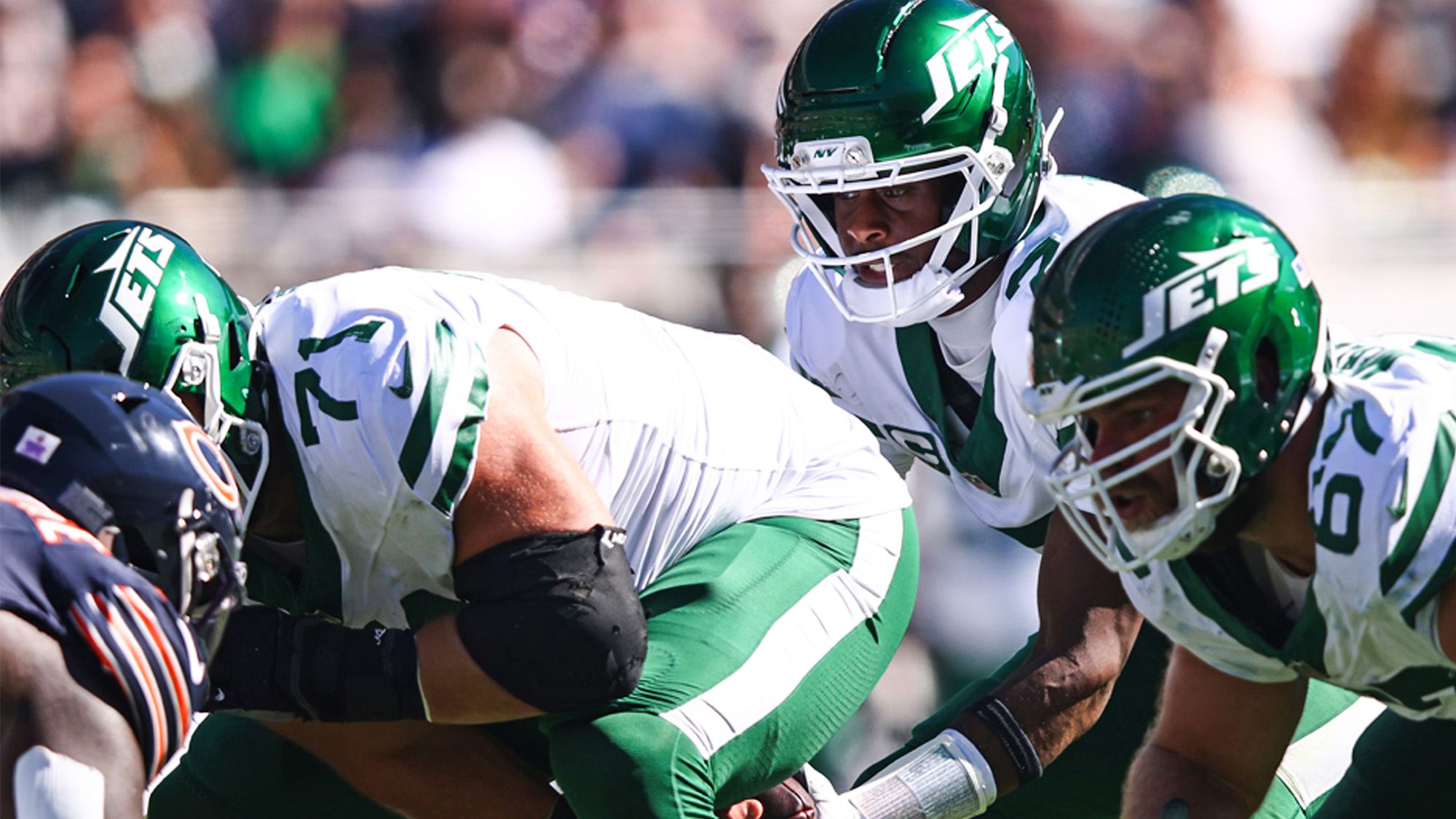
Entering the 2026 season, the New York Jets’ offensive line seemed to be shrouded in optimism for the first time in years.
Four games through the season, though, has the unit lived up to expectations, or has it fallen short?
How has the Jets’ offensive line fared?
After the first two weeks of the season, the Jets’ boys up front weren’t just living up to expectations; they were the league’s best pass-blocking team, according to Pro Football Focus.
Two weeks later, they rank 13th in PFF’s pass-blocking grade (65.3) and 13th in their run-blocking metric (66.3). So, based on those grades, the offensive line has been above average. If you said the Jets’ OL would be 13th in the league throughout the year before the season starts, I think many fans would have signed up for that.
On the surface, those grades are promising. It’s important to dig a little deeper, though.
In Weeks 2-3, in crunch time, the Jets’ pass protection flat-out collapsed. Across those two one-score losses, Geno Smith took five sacks in the fourth quarter and overtime.
It would also be naive to say that they have been a solid run-blocking team, regardless of what PFF says. The Jets’ run-blocking was horrific in Weeks 2-3. They had a great season opener against the Tennessee Titans in that area, and they improved on Sunday against the Chicago Bears, helping to explain their higher ranking there.
Still, the Jets are 30th in yards per rush attempt (3.4), and the run blocking deserves much of the blame.
From Weeks 2-3, Braelon Allen and Breece Hall combined for just 20 yards before contact on 38 carries. That comes out to roughly 0.5 yards before contact per attempt. In Week 1, they had 65 yards before contact on 32 carries, which equates to a much better 2.2 mark.
In defense of the offensive line, though, not all of the Jets’ run-blocking issues come from that unit. Tight ends Kenyon Sadiq and Jelani Woods have each struggled to block the run, which is crucial.
Over that rough two-game stretch, the biggest run-blocking culprit on the offensive line was Armand Membou, who earned a 45.0 run-blocking grade from PFF in those games. However, he improved sharply in Chicago, as that mark shot up to 92.7, leading all 191 offensive linemen to play a snap in Week 4.
Pass protection-wise, the Jets really imploded against Detroit. Olu Fashanu was charged with six pressures allowed, including three sacks. Jordan Meredith, replacing the injured Dylan Parham, allowed five pressures and two sacks on 28 pass-blocking snaps. Josh Myers, meanwhile, also allowed four pressures and a sack. The unit was a disaster.
On Sunday against the Bears, the OL wasn’t as bad, especially in pass protection. Throughout Geno Smith’s 18 dropbacks, the offensive line allowed two sacks and five total pressures. They could have been better, but it’s nowhere near the reason why the Jets lost.
The offense simply couldn’t sustain drives. Smith also needed to be better, completing just 53.3% of his passes.
It also worth noting that, while the Jets’ offensive linemen combined to allow just five pressures, Smith was actually pressured on nine out of 18 dropbacks, a very poor pressure rate of 50%.
Four of his nine pressured dropbacks, though, were not blamed on the offensive line. Pressure often got home because the ball was not out in time, whether due to Smith holding it too long or receivers not creating separation. Smith tied his season-high with an average of 3.12 seconds to throw.
At the end of the day, the offensive line has done some good and some bad. Snap to snap, the unit has flashed more positive than negative, but the pass protection needs to be better in crunch time. It’s also important to note that the team was without Parham for most of Week 3 and all of Week 4, who had arguably been the team’s best piece up front this year.
It will be an interesting test to see how the group looks in Week 5 against the Cleveland Browns after the Jets’ first real beatdown. They lost in Weeks 2-3, but it was nowhere near the fashion they lost in on Sunday.
