

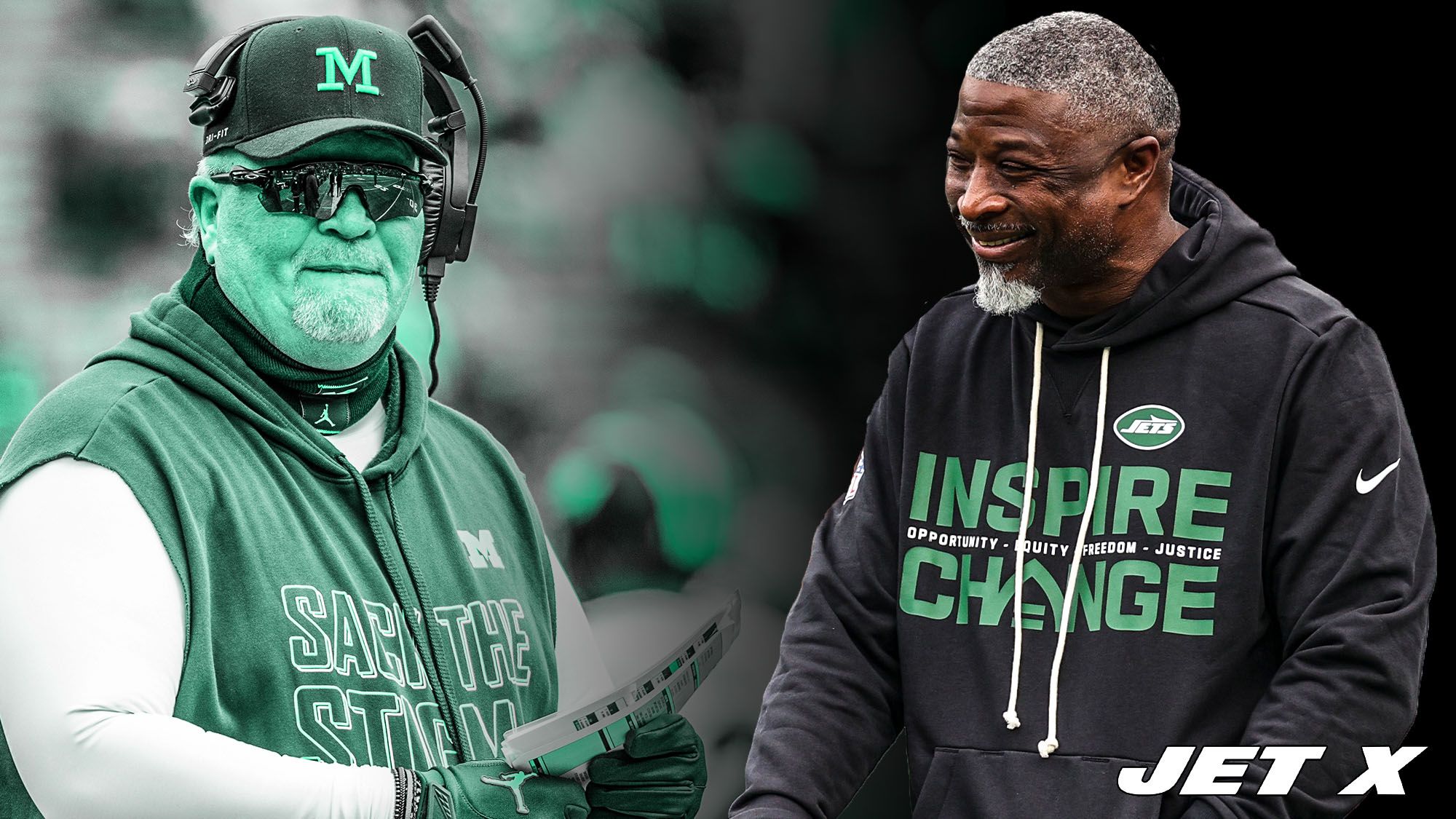
Wink Martindale is an excellent football coach. Make no mistake about that certainty.
Wink Martindale is also one of the most aggressive defensive coordinators the sport has ever seen. His over 48% blitz rate as New York Giants defensive coordinator in 2023 ranked among the highest in the league, as did his 44.7% mark the year prior (2022).
Whether it was his four-year stint as Baltimore Ravens defensive play-caller (2018-2021) or his two years in the same role for the Michigan Wolverines most recently (2024-2025), the man has never wavered from his “attack the quarterback” ways.
Wink is a guy who abides by the familiar “get after ’em” mantra around these parts — one Rex Ryan popularized in his six-year head-coaching stint over a decade ago. Perhaps this is why Martindale remains a somewhat popular fan choice to become the New York Jets’ next defensive coordinator.
The fans who want to see that happen received good news on Saturday, when it was revealed that Martindale flew to New Jersey to take a second interview for the job.
The fans who are a bit more cautious about making Wink the team’s next defensive boss remain locked into what ailed Aaron Glenn’s rookie head-coaching season with the Jets, and it doesn’t directly relate to the following simple formula…
Blitzing + modern football = bad.
Wink Martindale represents dangerous territory in a more fundamental fashion.
Defensive aggression isn’t inherently bad
Look, the aggressive defensive mind isn’t automatically a counterproductive idea. Brian Flores continues to represent the NFL’s mad bomber, and his Minnesota Vikings defenses have remained stout (finishing third in yards allowed per game this past season).
Following Flores’s league-leading 48.0% blitz rate, per Sharp Football Analysis, the Atlanta Falcons ranked second with a 33.9% blitz rate. One of the teams playing on Championship Sunday, the Denver Broncos, blitzed the quarterback 31.9% of the time this past season.
Rounding out the top 12 are the Kansas City Chiefs, Miami Dolphins, Tampa Bay Buccaneers, New York Giants, Pittsburgh Steelers, Chicago Bears, Dallas Cowboys, Cleveland Browns, and Indianapolis Colts.
While only three of the top 12 blitz-heavy teams made the playoffs, Wink’s aggression alone isn’t the reason for the concern from a Jets perspective.
Sending pressure religiously, despite every tangible stat making it clear that blitz rates have decreased significantly over the last 12-15 years, also isn’t inherently a bad defensive mantra to own. It’s simply a matter of understanding the present landscape.
Unlike the pre-2012 NFL, where guys like Rex could dial up elaborate blitzes that would send second-level defenders on a delayed trigger, today’s sport doesn’t provide enough time. Quarterback efficiency is all the rage, thanks to the offensive-focused rules, evidenced by sky-high completion percentages and historic low yards-per-completion marks.
There’s just not enough time in the dropback for those blitzes to hit home. Therefore, mugging the A and/or B-gaps with standing defenders has become standard across the league, as defensive play-callers need to at least give the offense something to think about pre-snap.
The danger of preconceived identities
If Wink Martindale sticks to his usual blitz-heavy ways as the New York Jets’ defensive coordinator, success is certainly possible. “Possible” is the keyword, however.
The main concern about Martindale is how specifically convicted the head coach is on his defense’s core philosophies.
Does Aaron Glenn want Wink because he thinks as he does, or because he wants an aggressively attacking defense? Is it similar in the way he thought about the also-old-school-type in Steve Wilks?
Or, does he want him because he believes he can be a tremendous play-caller in the modern National Football League?
Last offseason, Glenn made no bones about his team’s identity. He pointed to Justin Fields as his quarterback, hired Charles London as the quarterbacks coach, and drafted big fella Armand Membou in the first round.
Everything Glenn did pointed to a preconceived idea of who the 2026 Jets would be as a team. This includes deploying a blitz-heavy, press-man-specific defense.
That’s simply not the way to attack things — especially in today’s league.
Team identities are crucial, but they must be formed organically. Attempting to force-feed a preset identity down the throats of a particular roster creates a set of unfortunate circumstances that cannot be avoided in the end.
In other words, there’s nothing wrong with an NFL head coach wanting his offense to deploy an excellent rushing attack. There is, however, something extremely wrong if achieving that rushing success comes at the cost of other areas (i.e., passing game, offensive creativity, etc.).
That rushing attack must happen organically, so the competition can’t take advantage of those preconceived notions and goals. For those interested in an example, watch the Week 2 tape of the Jets’ 30-10 loss to the Buffalo Bills at MetLife Stadium, when Sean McDermott’s defense overplayed tendencies in a dominating fashion.
The way New York’s defense routinely featured a single-high look with man coverage — against Josh Allen — was beyond mind-boggling.
For Martindale’s potential role as defensive coordinator with the Jets, whether it’s the right idea boils down to the motivation behind the hire. Wink Martindale has rarely (if not ever) been a guy to flip his defensive philosophy, and that sort of conviction is precisely why the New York Jets suffered this past season.
