

The game of football is a wild concept. It’s as simple as it is complex, as physical as it is mental, and as lighthearted as it is bothersome in some cases.
On one hand, there’s no denying that each football team wears a unique identity on its sleeve. On the other hand, particularly in the modern NFL, where physicality has reached an all-time low, deploying the versatility of weekly strategy is as crucial as it gets.
Leaning on a specific coverage when the going gets tough is no problem; it’s a significant problem when the opponent is wholly comfortable facing said coverage.
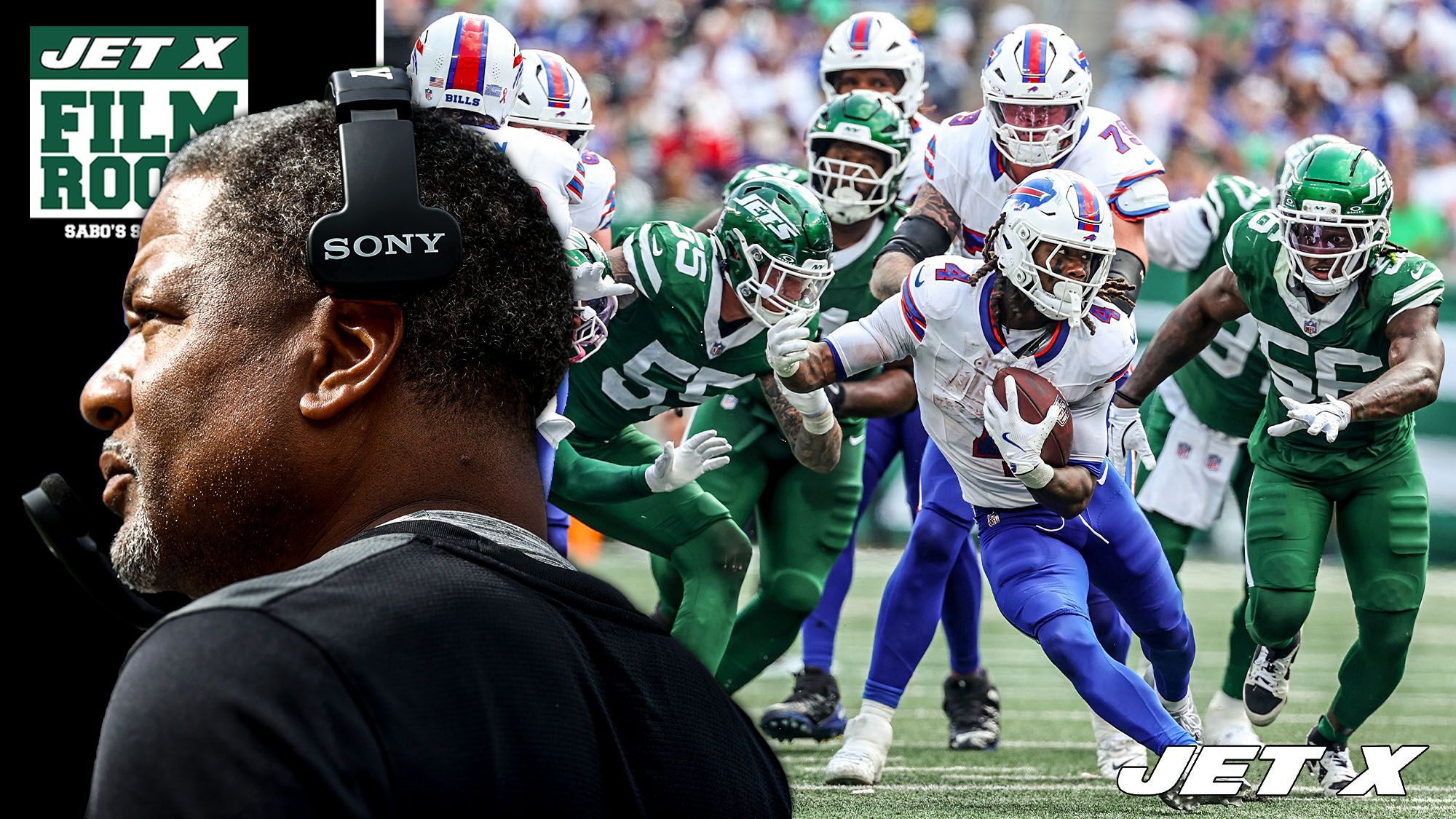
Aaron Glenn’s New York Jets defense was shredded by Josh Allen’s Buffalo Bills in Week 2. Most of this shredding occurred in man-to-man coverage. More specifically, the defensive coordinator leaned on Cover 1 in third-and-passing situations.
The same pattern occurred in Week 1, to a much lesser degree. Pittsburgh Steelers quarterback Aaron Rodgers, as did Josh Allen, knew precisely what he was looking at. The cherry on top was Bills’ backup quarterback Mitchell Trubisky, who promptly hit Joshua Palmer on an over route, in stride, against Sauce Gardner.
Something’s wrong when a backup quarterback is calmly dismantling a coverage so easily upon his insertion.
In addition to the Cover 1 predictability, it was as if the Jets did not game plan for Allen’s Bills at all. Instead of playing with a specific set of principles at the forefront of their minds, much of what’s on tape is more akin to Wilks’s defense taking on a generic quarterback.
The first third-and-passing down
The very first third-and-passing down in Week 2 resulted in a 40-yard rumble by Josh Allen.
On a third-and-8, Wilks calls a Cover 1 with a five-man rush. Off the top, playing man coverage against a quarterback with legs is a danger, courtesy of having defensive backs needing to chase receivers across the field.
Backs will naturally be facing the line of scrimmage.
Secondarily, it’s a Cover 1 press. Therefore, the man coverage call becomes even more dangerous, as the hard cornerbacks will turn their hips (to run with the weapon) immediately.
Hey, it’s not necessarily an automatic death. Man coverage can (and should) sometimes be called against a quarterback with legs, but it demands that the defensive front remains responsible.
That did not happen.
Not only did Wilks call a three-man pass-rushing game in an effort to get to the quarterback, but the straightforward side of the rush did not do its job. Micheal Clemons and Jermaine Johnson did not remain responsible in their contain-esque rushing lanes.
Nevertheless, a quarterback spy will handle things even with all these issues—man coverage, a three-man pass-rushing stunt, and irresponsible rush lanes. Right?
Well, not exactly …
Although MIKE Jamien Sherwood is responsible for the running back on this play (a green dog that allows him to rush the passer if the back stays in pass pro), I’d be stunned if he’s not also a hybrid spy in this spot. Facing a guy like Allen demands such attentiveness.
Unfortunately, Sherwood inexplicably guesses to the right, allowing Allen to escape to the defense’s left, right where Clemons was driven to the ground.
Sherwood must catch the quarterback here, fully understanding the situation. It’s third-and-8, which means the sticks must be the priority.
The backup QB slices with ease
The next third-and-passing situation was a third-and-19 on the fringe of field goal territory. Wilks dialed up a zone, which worked.
Unfortunately, Buffalo was bailed out with the Clemons roughing-the-passer call.
After Justin Fields’ fumble, Buffalo faced a third-and-8 situation at the Jets’ 10-yard line. Considering every goal line or near-goal line coverage is some form of press man, we also bypassed this one.
Mitchell Trubisky’s 32-yard strike to Joshua Palmer brings us to the next third-and-passing down.
Remember, this is Trubisky’s first play of the game, after replacing the bloody-nosed Allen. Finding a more confident strike by a backup NFL quarterback is tough.
From the jump, it’s not a mystery what the Jets are running here. They show a single high safety with press across the board.
Because Sauce is in press on the No. 3 to the trips’ side, Michael Carter II plays off a bit (to allow for a staggered look, which helps prevent rubs/picks). The only mystery takes place up front.
How many Jets will rush the passer? It’s a wide look with Quincy Williams as the single mug in nickel. Other than that, the quarterback knows exactly what he’s facing on this play.
Therefore, they run a man-beating concept since he knows it’s man coverage (a type of hi-low running underneath the Palmer over route, which becomes the target). Worse yet, Wilks drops Quincy on this play as a dedicated spy …
… against Mitchell Trubisky.
Let’s get this right: Instead of running a dedicated spy against Josh Allen (as seen in the first example), we do so against Trubisky? Alrighty.
It’s safe to say the Jets would have been in a much better position if that extra player had been used in a robber-type scenario (i.e., Cover 1 Robber).
3 plays later
Just three plays later, and with Allen back in the game, another third-and-passing down strikes. Yet again, Wilks dials up a Cover 1 variety.
This time, the extra defender is in a dedicated spy (Quincy Williams). Identical to the Trubisky-Palmer connection, he mugs the A-gap to take away the center and set up one-on-one pass-rushing situations, before dropping into a dedicated spy responsibility.
On the back end, it’s the same song and dance: Cover 1.
Since a dedicated spy is called, there’s no help near the sticks (no robber, no mid-zone, etc.). I’d love to see Andre Cisco playing things tighter as the single-high safety, but I’d also love to see more of a mixed bag in third-and-passing situations.
Here, Tony Adams doesn’t do a terrible job against Dalton Kincaid, but Allen’s accuracy gets it done. In any event, the defensive holding against Adams results in an automatic first down.
It’s yet another example of the Bills’ offense (and quarterback) feeling wholly comfortable with what they’re seeing pre- and post-snap.
Final thoughts
Steve Wilks’s defense showed a pre-snap single-high look while playing a variation of Cover 1 (mostly press) on six of the nine total third-and-passing downs (more than six yards to go), while not counting any goal-line-type situations.
Worse yet, two of the three times they broke convention came much later in the game (with the Clemons roughing penalty on third-and-19 representing the lone exception).
The only time the Jets did not show a single-high pre-snap was on a third-and-23 early in the fourth quarter. They started two-high but moved into a 3 Buzz look post-snap.
From a game-planning perspective, I get it: The Jets looked at the Bills’ weapons and thought, “These guys don’t scare us, and we trust our defensive backs to lock them up across the field, while bending a bit with the extra defender, placing him as the fifth pass-rusher, as a dedicated QB spy, or even in a mid-zone or robber area.
The problem comes when one realizes just how comfortable Josh Allen and the Bills were facing the defense and how predictable it was. Every high-leverage passing down felt too easy for the road team.
Leaning on man coverage is a perfectly acceptable strategy. However, doing so without executing anything resembling a Buffalo Bills-specific game plan and allowing Josh Allen to look so comfortable throughout the entire game is the football sin identified.
