

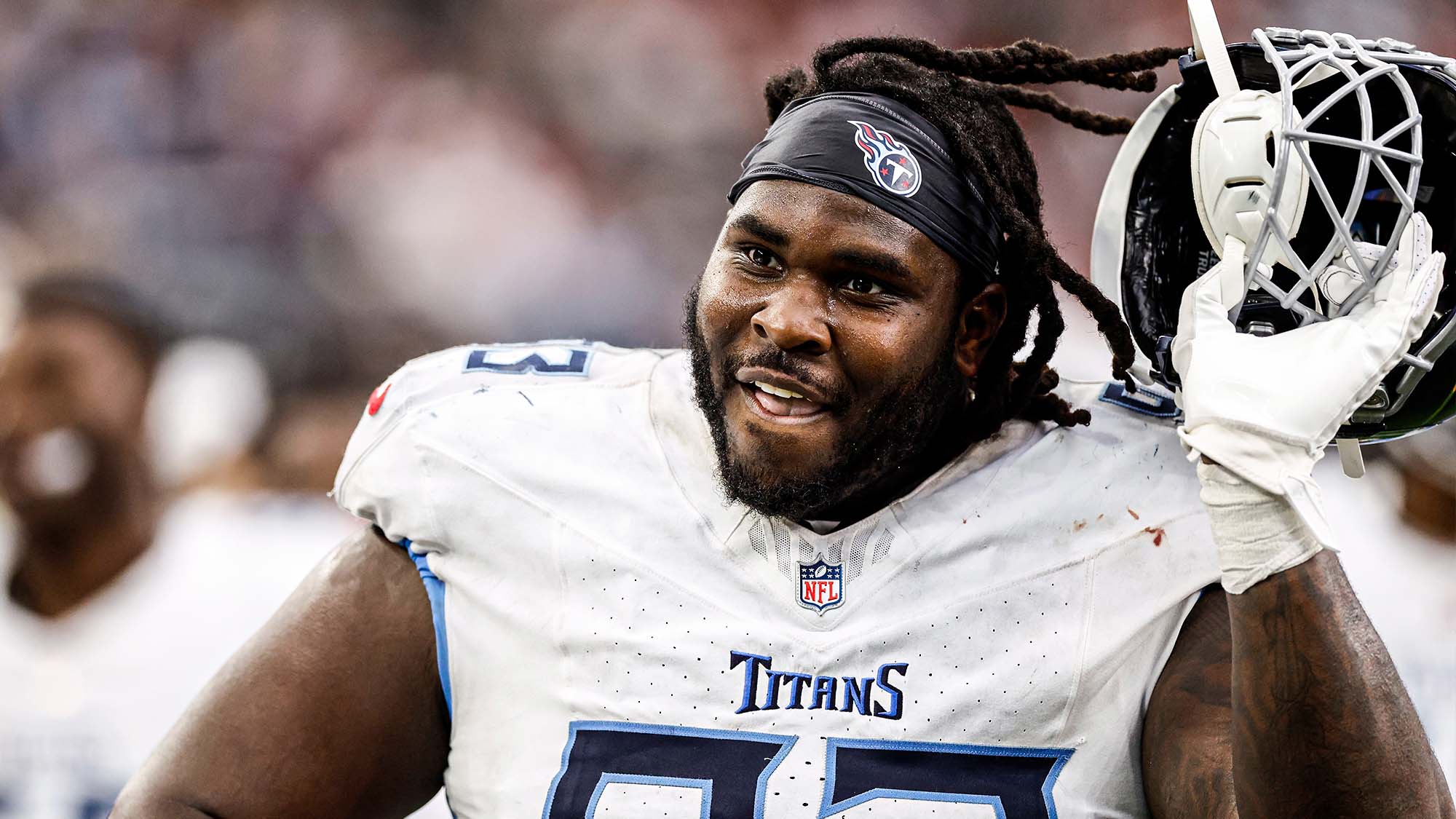
On Thursday morning, the New York Jets shook up their defense by trading Jermaine Johnson to the Tennessee Titans for T’Vondre Sweat.
So, who are the Jets getting in the former Titans defensive tackle?
Let’s dive into the player profile of the newest Jet.
Background
A five-year player at Texas, Sweat was chosen 38th overall in the second round of the 2024 draft.
Coming out of Texas, Sweat was renowned for his otherworldly size, measuring in at 6′ 4½” and 366 pounds. His athleticism did not blow scouts away (4.27 Relative Athletic Score), but the sheer power he displayed on film was undeniable. As NFL.com’s Lance Zierlein wrote of Sweat, “it takes a village to try to uproot him and move him out of the way.”
Despite his lack of athleticism, the Titans gambled that Sweat could translate his dominant college production to the NFL. In 2023, Sweat was PFF’s top-graded defensive tackle in the nation with a 91.7 overall grade. That included a top-ranked 92.0 run defense grade and a ninth-ranked 85.3 pass-rush grade.
Sweat’s elite production and mammoth frame were enough to get him drafted early in the second round, with his age (five years in college), lack of athleticism, and run-game-centric skill set being the primary concerns that kept him out of the first round.
Titans role
Sweat played in 29 games for the Titans across his first two NFL seasons, starting 28 of those. For someone his size, Sweat handled an impressively large snap count.
Across his 29 appearances, Sweat averaged 37.2 defensive snaps per game. His role shrank slightly in his second year, as he declined from 41.1 snaps per game as a rookie to 31.8 this past season. On a percentage basis, he went from an average snap ratio of 66% in 2024 to 51% in 2025.
While Sweat has played a decent amount of nose tackle in his career, he probably didn’t line up there as often as you think.
According to PFF, Sweat has logged 14.6% of his career snaps lined up over the center (either 0 or 1-tech), compared to 82.1% over the guard (2i, 2, or 3-tech). He rarely kicks out and lines up over the tackle (4 or 4i-tech), doing so on a paltry 3.2% of his snaps.
In 2025, though, the Titans pumped up Sweat’s usage as a nose tackle. After he played just 11.9% of his snaps over the center in 2024, that number rose to 19.7% this past season.
Sweat’s role leaned toward running situations, although he wasn’t as one-dimensional as you would expect for a 366-pounder. In 2025, 47.4% of his snaps came on run plays, ranking in the 71st percentile among defensive tackles who played at least 300 snaps. So, yes, his role leaned toward the run game, but not to an extreme degree.
As we’ll see later on, that’s because Sweat is not a one-dimensional player.
Production
Run defense
Of course, when you use a second-round pick on a 366-pound defensive tackle, it’s mainly for him to stop the run.
And the Titans got what they hoped for.
Sweat has stood out as a plus run defender in each of his first two NFL seasons. As a rookie, his 75.0 run defense grade at PFF ranked eighth-best among the 99 defensive tackles with at least 150 snaps against the run. He boosted that number to 79.3 in 2025, jumping to fourth-best.
Sweat isn’t extremely active at making stops on his own. This past season, he recorded 11 run stops on 180 run defense snaps, a 6.1% rate that placed him in the 42nd percentile among qualified defensive tackles.
While Sweat doesn’t stockpile stops at an elite rate, his top-notch run defense grade stems from two skills: reliable tackling and setting up stops for his teammates.
Sweat is a phenomenal tackler. He has been credited with just four missed tackles in his career, with one against the pass and three against the run. His career missed tackle rate is a measly 4.4%, slightly more than one-third of the 2025 positional average (12.0%).
On top of this, Sweat routinely popped off the film as a player who gobbled up blockers and cleared lanes for his teammates. This is the type of off-the-stat-sheet impact that can be captured in a player’s run defense grade despite the lack of box-score production to go with it.
Sweat should immediately upgrade a Jets run defense that was pummeled up the middle in 2025.
Pass rushing
Perhaps the most appealing aspect of Sweat’s game is that he is no slouch as a pass rusher.
Run-stuffing defensive tackles who cannot rush the passer are liabilities in today’s game. You can’t hide a player from pass rushing; even if you limit him to early-down plays and short-yardage situations, he is still likely going to see pass plays on around half of his reps.
So, if a guy is a total zero as a pass rusher, he is going to be a total zero on around half of his plays. That’s hard for a defense to deal with, no matter how good he is against the run. New York saw this in 2025 with Harrison Phillips, who remains a quality run stuffer but offers little to nothing as a pass rusher at this stage of his career.
The Jets won’t have to worry about that with Sweat.
While run defense will always be the primary appeal of his game, Sweat can be trusted to remain a factor if he is on the field for a pass play.
In 2025, among the 97 defensive tackles with at least 200 pass-rush snaps, Sweat ranked 16th in PFF’s pass-rush grade (74.1), 36th in pressure rate (9%), and 40th in pass-rush win rate (9.4%). Those are above-average numbers across the board.
As poor as his athletic testing was, Sweat’s film tells a different story. He has fantastic quickness and finesse for a 366-pounder, allowing to make more pass-rush plays than a man his size has any right to.
Injuries
Sweat never missed a game in five years at Texas, although he suffered a shoulder injury in the 2020 Alamo Bowl, which required surgery during the 2021 offseason. This did not cut into his 2021 season.
Sweat did not miss any games in his rookie year with the Titans. He was listed as questionable in three games, twice with a hip and once with a shoulder.
In 2025, Sweat missed five games early in the season with an ankle injury. He returned for Tennessee’s final 11 games and did not miss a beat from a production standpoint, although the Titans cut his snaps a bit compared to his rookie year. Sweat was never listed on the injury report outside of his ankle injury.
Takeaways
In Sweat, the Jets are getting a third-year defensive tackle with a second-round pedigree who has already sustained two seasons of consistent above-average production in both phases of the game, looking particularly excellent as a run defender. He is a gargantuan human who projects as an excellent fit to play nose tackle in the Jets’ 3-4 scheme under Aaron Glenn.
Sweat was an early second-round pick two years ago and has played like it. So, the Jets essentially traded Johnson for an early second-round pick.
That’s a steal if you ask me.
