

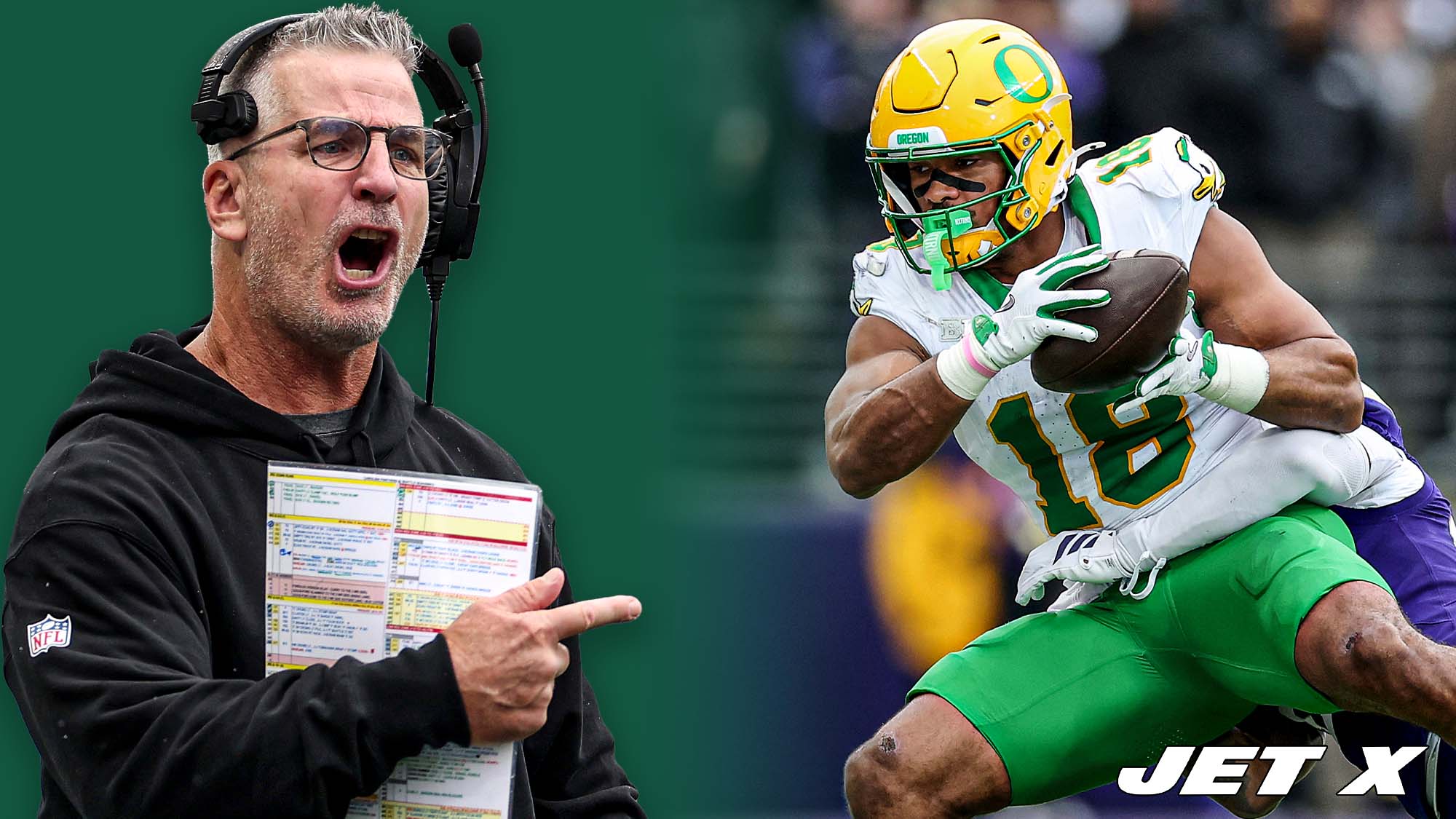
When the New York Jets hired Frank Reich as their offensive coordinator, it seemed that the team was preparing to run an offense that was heavily reliant on 11 personnel packages: one running back, one tight end, and three wide receivers.
Across his six seasons as an NFL head coach in Indianapolis and Carolina, Reich consistently utilized 11 personnel more than the average NFL team. In his two most recent seasons, Reich bumped his 11 personnel usage rates up to sky-high levels.
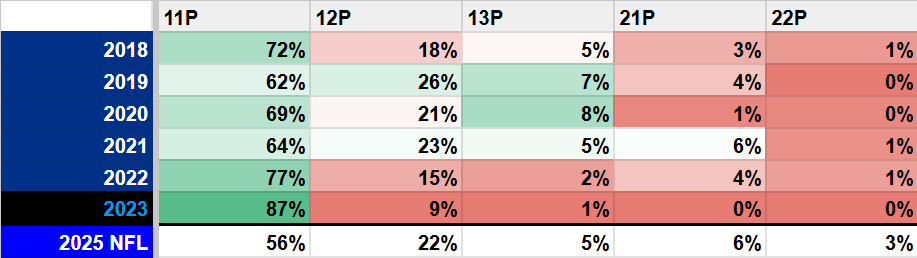
But after the first round of the 2026 NFL draft, it seems as if Reich and the Jets are ready to scrap any plans of an 11 personnel-heavy offense.
With the selection of Oregon tight end Kenyon Sadiq at No. 16 overall, New York has now selected two tight ends in the top 50 picks of the last two drafts, as they chose Mason Taylor in the second round (42nd overall) of the 2025 draft.
Taylor had a promising rookie year, finishing first among rookie tight ends and seventh among all tight ends with 11 contested catches. He did it on just 14 contested targets, giving him a 78.6% contested catch rate that ranked second among all tight ends (min. 10 contested targets) behind only George Kittle (84.6%).
Given what Taylor displayed as a 21-year-old rookie, and that this same regime invested a second-round pick in him, it stands to reason that he remains squarely in the team’s plans; Sadiq was not chosen to replace him.
Rather, Sadiq was added to play alongside Taylor.
That means a schematic shift is in store for Reich.
Frank Reich’s impending scheme change for Jets
After relying on three receivers and one tight end for the vast majority of his plays across his last two seasons as an NFL head coach, Reich and the Jets seem prepared to become one of the league’s top users of 12 personnel (one running back, two tight ends, two wide receivers).
In today’s NFL, 12 personnel is becoming increasingly popular after falling to the wayside over the previous decade. Why? Well, defenses have become smaller and smaller in response to the uptick in 11 personnel usage and general speed on offense. Gone are your 255-pound thumping linebackers, and in are your 230-pound rangy cover men who used to play safety (hello, Jamien Sherwood).
Thus, the pendulum has swung back to favoring physicality on offense. With defenses getting so small, especially at linebacker, it has become more advantageous to build an offense around size and strength rather than speed. Defenses are equipped to keep up with speedy weapons nowadays, but these quasi-safeties at linebacker can be bullied.
If you look at the teams and coaches who are leading the modern wave of offensive innovation around the NFL, you will typically see them relying on some sort of heavy personnel package, even if it isn’t exactly 12 personnel.
Led by OC Klint Kubiak, the defending Super Bowl champion Seattle Seahawks used 12 personnel on 29.9% of their plays in 2025, ranking eighth in the league. Their fiercest division rival (and the true runner-up of the 2025 season, as opposed to the Patriots), Sean McVay’s Los Angeles Rams, led the league in 13 personnel usage (3 TEs) at 30.5%, more than double any other team.
When the Detroit Lions won 15 games in 2024, offensive coordinator Ben Johnson had the team ranked eighth in 12 personnel usage (29.3%), while they also ranked in the top 16 of both 13 personnel usage and 21 personnel usage. Moving over to Chicago in 2025, Johnson had the Bears ranked sixth in 12 personnel usage (32.6%), helping to spark a drastically improved season.
Until defenses dial back their pursuit of speed, size on offense will be an advantageous route in the modern game. Eventually, defenses will respond by beefing back up, and at that point, the offensive pendulum will swing back to favoring three-receiver sets and collective speed.
But as we sit here today, most of the league’s top innovators on offense are counting on heavy personnel packages to create advantages. For that reason, Jets fans should be excited about the fact that the Sadiq pick signals a modern shift for the team’s offensive vision.
At 64 years old with no semblance of NFL success since 2021, Reich comes to New York with significant concerns about whether the game has passed him by. Adaptability and innovation were major question marks for him in his two most recent seasons, which both culminated in mid-season firings.
By selecting Sadiq, Reich has signaled that, at least in one way, he is prepared to shift his offensive philosophy in a modern direction. It doesn’t guarantee successful results on the field just yet, but it’s an encouraging start.
If you’re a Jets fan who is excited about the Sadiq pick, this beneath-the-surface takeaway only further enhances the selection. But if you’re a Jets fan who is down on the pick, this is a silver lining that should at least raise a slight green flag about the team’s leadership, even if you feel iffy about the pick itself.
