
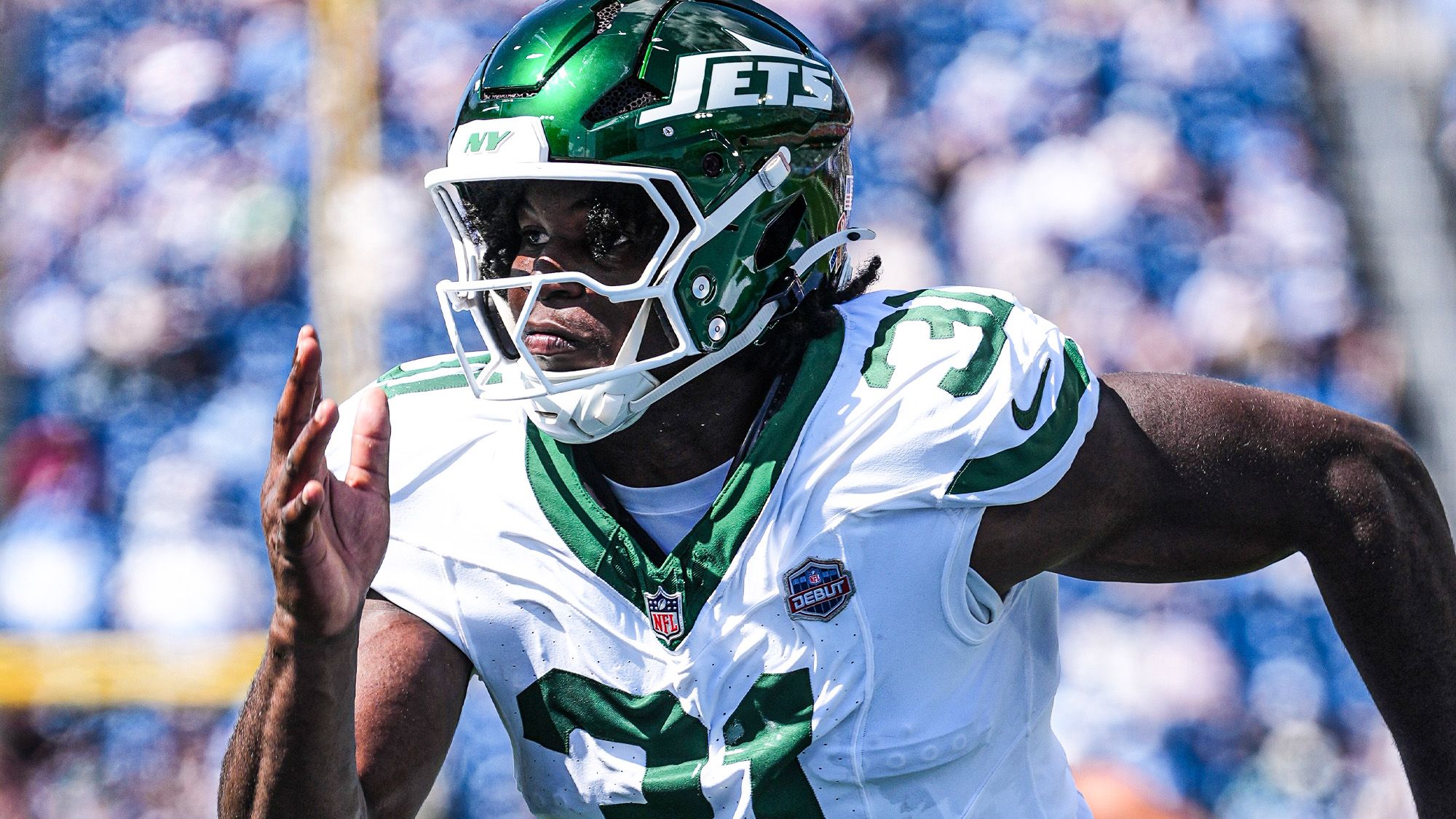
Being the second overall pick in the NFL draft carries massive expectations—especially when you head to a team that hasn’t made the playoffs since you were seven years old.
That’s the situation faced by New York Jets defensive end David Bailey, who is tasked with leading the turnaround of a unit that had 26 sacks, four takeaways, and 503 points allowed in the grim campaign that preceded his arrival.
Bailey’s first two NFL games have drawn opinions all over the map. Some Jets fans are frustrated with the pick, while others tout him as someone who is already one of the league’s best defenders.
How has Bailey really played through two games?
Let’s take a pragmatic look at Bailey’s performance so far.
The good: Overall activity
One thing is for certain about Bailey’s first two games: He’s been all over the field.
Bailey’s coaches have already shown a ton of trust in him. With projected starting defensive end Joseph Ossai absent, the Jets have entrusted Bailey as the anchor of their defensive line. He has started both games and played 72% of the team’s defensive snaps, leading New York’s defensive linemen.
With the ample snap count, Bailey has found multiple ways to get his fingerprints all over the game.
Through two contests, Bailey has racked up seven total tackles, eight total pressures (two of those being sacks), and a forced fumble. Perhaps the most quietly impactful part of his resume is that he has also drawn two holding penalties.
Bailey’s eight total pressures (based on Pro Football Focus’ tracking) have him tied for the 13th-most among all NFL edge rushers, which is a promising place for a youngster to rank through two games. It ranks first among rookies and even ties him with 2024 first-rounder Laiatu Latu for second among edge rushers drafted within the last three years, trailing only Dallas Turner of the Vikings (20).
The Jets have used Bailey in a versatile fashion, rotating him between a defensive end in four-down looks and an outside linebacker in 3-4 looks. He’s even been asked to drop into coverage on six of his 78 defensive snaps (8%).
Bailey has made an impact on those coverage reps. On one play, he diagnosed an outside screen pass and got in the passing lane, forcing Packers quarterback Jordan Love to tuck the ball and run, and Bailey rallied for the sack. Later in the game, Bailey forced a fumble while stopping tight end Tucker Kraft for a short gain after a pass completion.
No. 31’s name has been called plenty of times through two weeks. For a guy who was often pigeonholed as a pass-rush specialist throughout the summer, he has shown that he is more of an all-around football player than given credit for.
Can he stop the run?
As for the hot topic around his game, run defense, Bailey has been relatively nondescript through two weeks, not standing out as a major positive or negative.
Bailey has yet to be credited with a missed tackle against the run, but he also yet to record a run stop. He has three total tackles in the run game, although they came at an average of 7.0 yards downfield. There have not been many noticeably poor edge-setting reps on runs in his direction, though.
Overall, Bailey has a respectable 66.5 run defense grade at PFF, which lines up fairly well with the film. His run defense has been a non-story so far, which could be considered a positive based on how some analysts viewed him in this phase coming out of Texas Tech.
Work in progress: Pass-rush consistency
Bailey is still acclimating to the pro level as a pass rusher.
While Bailey’s eight total pressures are an impressive number through two games, most of those pressures were hustle plays in which he chased the quarterback down outside of the pocket, rather than pure pass-rush wins in which he quickly beat his blocker to blow up the play. On both of his sacks, Bailey merely chased the quarterback out of bounds for a one-yard loss.
It’s excellent that Bailey has shown off a blend of a high-level motor and elite speed to become a rangy chase-down artist, but the Jets drafted him second overall to be a consistent pass-rush winner, and they are still waiting to see that aspect of his game.
PFF’s metrics reflect Bailey’s slow start as a pure pass rusher. His 6.3% pass-rush win rate ranks 65th out of 77 qualified edge rushers, while his 62.0 PFF pass-rush grade ranks 42nd.
Of course, we’re only two games in. Bailey has plenty of time to develop his pass-rush game. Facing NFL tackles (even low-level ones) is a whole different animal than facing Kansas tackles, and it takes time for young players to acclimate.
Jets fans shouldn’t be too worried about Bailey’s lack of pass-rush production just yet. Over time, though, the goal is for Bailey to fly up the leaderboards in metrics like pass-rush win rate and PFF’s pass-rush grade.
Those are the types of metrics that reflect how much havoc a pass rusher causes in the backfield through his ability to win one-on-one reps. Being able to do that with a high degree of consistency is the rare, premium skill that gets prospects like Bailey drafted second overall.
The promising news is that, while he has not delivered the desired results yet, Bailey has shown off the unique traits that give him such a high ceiling. According to Next Gen Stats, Bailey is averaging a 0.75-second get-off time, ranking seventh-fastest among 92 edge rushers with at least 40 pass rushes.
That’s the exact on-field translation that you want to see from a guy who ran a 4.50 and posted a 129-inch broad jump. Bailey has carried over his explosiveness to the NFL field, proving he is more than a workout warrior or someone who merely looked more athletic than low-level competition at Texas Tech.
The next step for him is figuring out how to maximize that explosiveness by translating it into pass-rush wins. That could take time, but Bailey’s college film shows that he is more than capable. He has a wide repertoire of pass-rush moves in his toolbox.
Like any great college pass rusher before him, Bailey has to master the timing and technique to make those moves work against professionals.
Bailey’s outlook moving forward
What’s exciting about Bailey’s start is that he has established a high floor for himself. Even if nothing else changes about his game (which, of course, is not the expectation), he is already doing quite a bit to help the Jets’ defense.
Bailey hasn’t even excelled yet at the thing he was drafted to do—winning around the corner for high-quality pass-rush wins—and he has still managed to use his motor, speed, and instincts to get his fingerprints all over the game.
The fact that Bailey ranks 13th among edge rushers with eight total pressures (4.0 per game) without even coming close to his pass-rush ceiling is a scary sight for the AFC East. Imagine how high he could rank if he starts tacking on a few clean wins off the edge per game.
For now, Bailey’s performance does not warrant extreme opinions on either end of the spectrum. As a No. 2 overall pick, he is certainly capable of much better, particularly in the premium area that he was primarily drafted to impact. At the same time, he’s done a lot of promising things. He deserves time to bring his game together and gradually climb toward his ceiling.
