

The New York Jets’ offense was humming against the Pittsburgh Steelers. The offensive line dominated the trenches, which earned them, offensive line coach Steve Heiden, and offensive coordinator Tanner Engstrand, A+ grades.
Quarterback Justin Fields gets an A-, as his superbly played game is an indisputable idea. If that’s not enough, the Jets’ run defense also comes away with a passing defense against the rushing game, allowing just 53 yards on 20 attempts (for a paltry 2.7 yards-per-carry number).
Yeah, you, the hardened Jets fan, already know where I’m going …
What in the world happened to Aaron Glenn’s pass defense?
Busted coverages and pre-snap checks
While Aaron Rodgers didn’t classically torch the Jets’ defense, he put the Steelers in a great position. Far too often, Rodgers controlled the line of scrimmage to the point that Steve Wilks’s defense had few answers.
It’s one thing to want to directly pick on a specific cover defender; it’s another thing entirely to actually have the wherewithal to execute it. Rodgers, knowing precisely what he saw before the snap (while at the line of scrimmage), consistently knew how to beat Brandon Stephens.
Even worse was the idea that Rodgers (and offensive coordinator Arthur Smith) continuously called man-beating pass concepts against man coverage and zone-beating concepts against zone. In this league, it’s extremely difficult to stop the pass when the offense is always in the right look.
It’s damn-near impossible to stop it when stuck in the wrong coverage and against perfect ball placement. That’s just the reality of this game in the modern NFL—courtesy of the defensive-discriminatory rules.
Let’s begin at the top before we dig into the entirety of the New York Jets’ passing coverage woes. What happened on Aaron Rodgers’s first touchdown pass of the game?
Pre-snap look and situation
- Steelers’ second-and-7 from the Jets’ 22-yard line
- 3:44 remaining in the first quarter
- Jets 3, Steelers 0
- Offense: 11 personnel (3 WR, 1 TE, 1 RB)
- Defense: 4-2-5 Nickel (3 CB, 2 S, 2 LB, 4 DL)
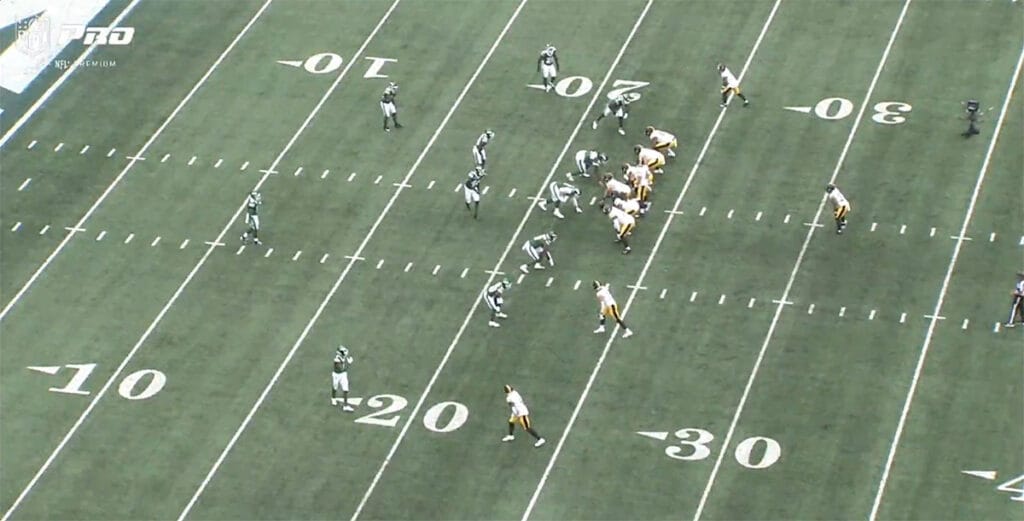
Pittsburgh comes out in a balanced look out of 11 personnel. The defense assuredly calls “strong left” against the run (thanks to the inline tight end on the offense’s right), with most likely a passing strength to the right side (twin receivers).
The wrinkle that Steelers offensive coordinator Arthur Smith incorporates is to sneak the Z receiver into a motion that places him inside the Y (tight end). He does this to try to take advantage of the Jets’ tendency to aggressively use their boundary cornerbacks in the unit’s run fits—when the boundary corner has no receiver on that side.
The route concept
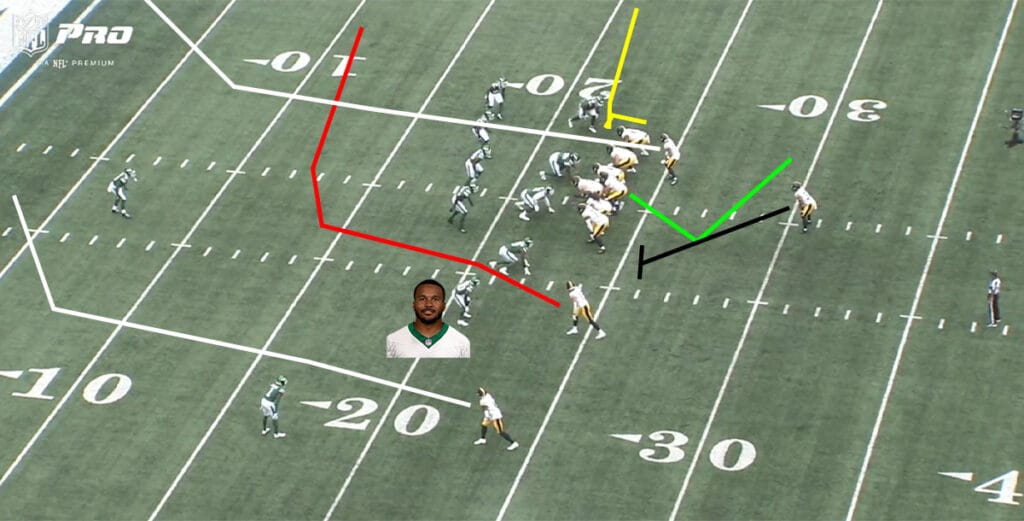
As seen from the above image, the Steelers run a play-action that gets Aaron Rodgers out on the edge just a tad. It turned out to be the perfect call considering Wilks’s defense was aggressively on its toes, expecting a run.
The action begins with the slot weapon, Ben Skowronek, who’s the man who scores the touchdown, as well as Jets’ slot corner Michael Carter II.
Cover 3 zone and match look
The following is what a spot-drop Cover 3 zone would look like:
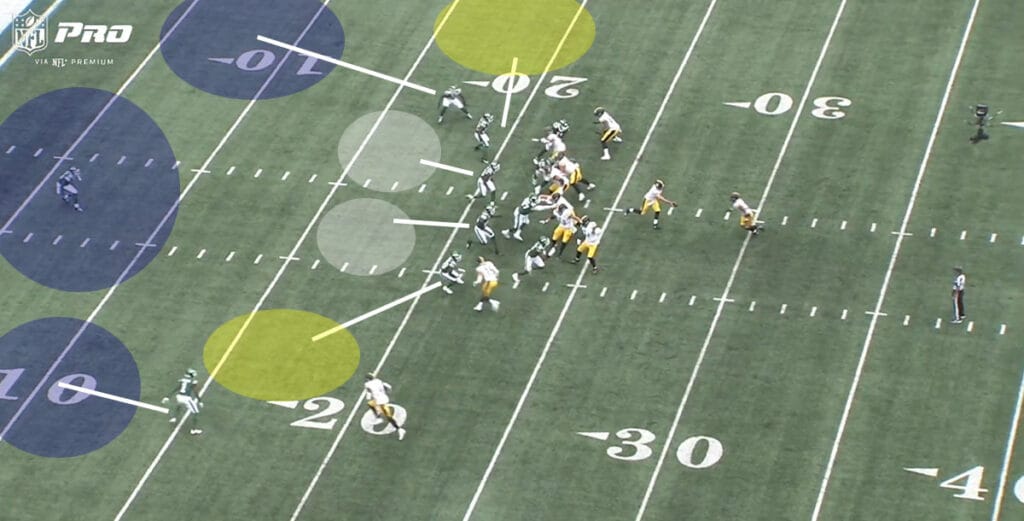
Here’s how a Cover 3 match coverage would play out via each defender’s primary read:
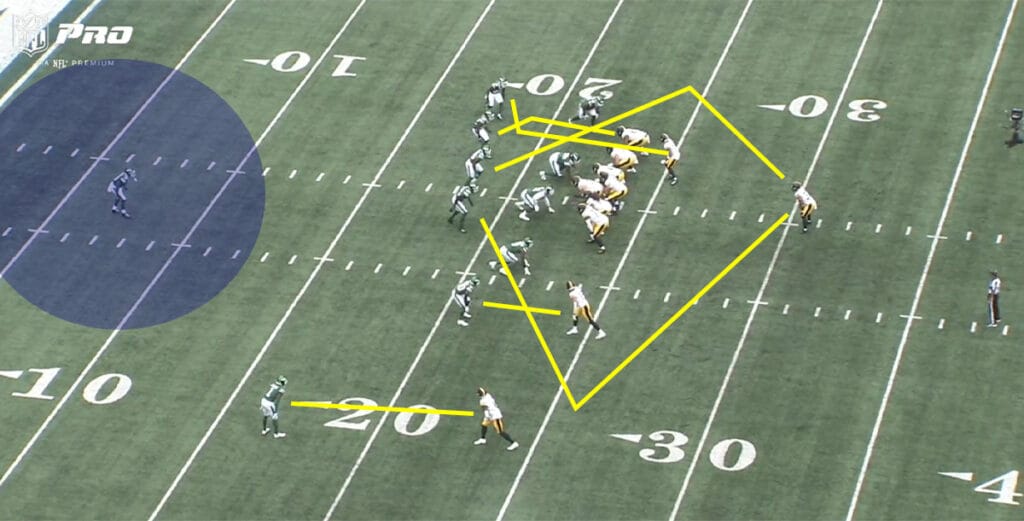
Jamien Sherwood and Quincy Williams are matched up with Jaylen Warren in the backfield due to a first-to-flat situation. If Warren releases to the left, Quincy is responsible. If Warren releases to the right, Sherwood picks him up.
Then again, Tony Adams cannot be taken out of the equation. If Adams, who started 2-high but walked down into the box, is firmly in the mix with the backers, he would be the man with first-to-flat responsibility to the left.
In-action coverage
Interestingly, that’s precisely what happened. Adams picks up the late-releasing tight end who darts to the flat, while Stephens appropriately carries the Z receiver who sneaks through the line to get vertical.
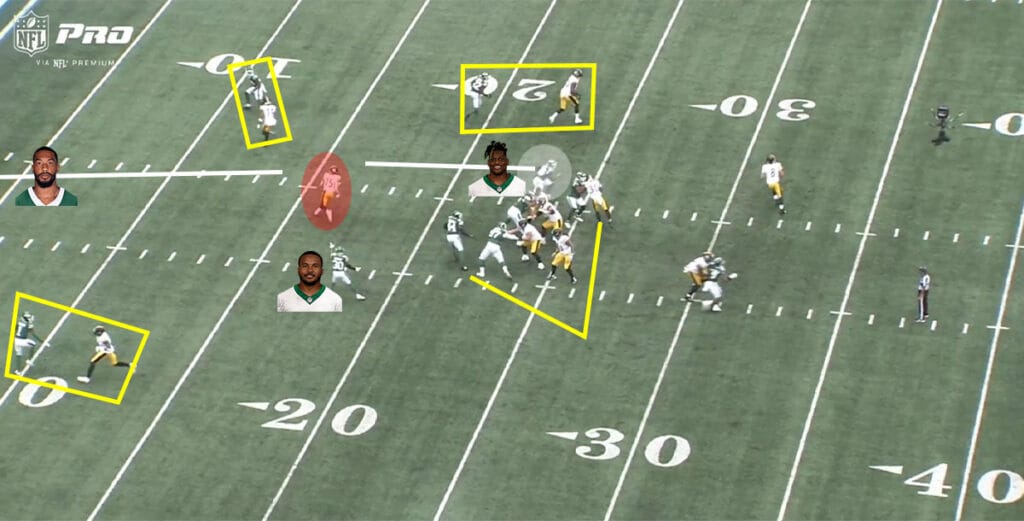
We can see Carter II pointing to Skowronek running free across the middle of the field, yet we’re unsure whose responsibility it is.
If a specific call was on for safety, it may have been Andre Cisco’s job to drive down on the crosser. A different type of call could have made it Quincy Williams’s job to fill the mid area.
It’s tough to imagine that Jamien Sherwood screwed up thanks to the play-fake running to his side of the defense, meaning he would be the man who picks up Jaylen Warren out of the backfield (to that side, the defense’s right).
Who’s at fault?
In any event, it’s easy to see the problem Aaron Glenn’s defense has here:
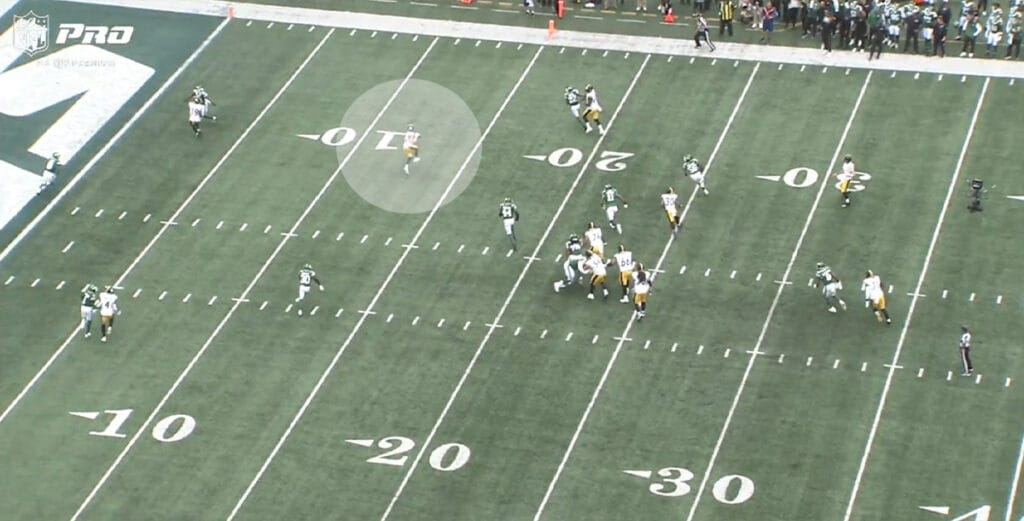
Carter played it in a spot-drop-type fashion, whereas most other defenders played it more in a match fashion.
Although some would argue that proves Carter is at fault, that’s not true due to how natural it was for Stephens to carry the Z vertical route, Sauce Gardner to run with the back-side corner, and Tony Adams to hop into the strong-side flat. Whether it’s a Cover 1 man coverage or Cover 3 match, each responsibility would look the same.
We don’t know who’s at fault because we don’t know any of the specific calls (beyond Cover 3 match or man). At the very least, we’re confident that the triangle of Michael Carter II, Andre Cisco, and/or Quincy Williams has to take the hit here (one, two, or all three players).
