
When a man finds himself cornered, the juices naturally flow, and instinct takes hold.
First comes the realization. Next comes quick thinking, no matter how brilliant the thought may or may not actually be.
Finally comes the fight — the last line of defense that’s destined to play out in some form or fashion, win or lose. There’s just no way around that fact when feeling cornered, dumped on, and counted out before the ref officially stopped the bout.
New York Jets head coach Aaron Glenn knows the feeling all too well.
Currently working his second offseason as the Jets’ football boss, Glenn’s future is transparently uncertain. Winning just three games the season prior — in today’s fast-moving NFL — will automatically create such a murky scenario.
Glenn is well aware of this reality. It’s why the Jets have acquired a specific type of player — one that Glenn is particular about in relation to how he envisions his team playing come September.
When a man finds himself cornered, he fights for his life in a way that can best reflect who that man is to his core.
Here come the dogs
Once upon a time, Aaron Glenn was Pete Carroll’s 1994 rookie cornerback who had a preseason nightmare, muffing three punts. Although his punt return career was halted, Glenn recovered to become the second greatest cornerback in franchise history.
He had to fight like a dog out of that less-than-ideal situation. These days, while feeling one of the hottest seats in the league, Glenn opted for a history of violence on the 2026 open market.
Each of the Jets’ new players is what Glenn would call a “dog.” He’s physical, has had to pick himself up off the mat at one point in his professional career, and in the case of the front-seven players, he’s more than willing to play the run with disrespectful violence.
It appears that Glenn has had enough of his defense resembling a powder-puff, unwilling to put up any resistance. It seems as though he’s sick and tired of watching opposing offenses trample on them while marching up and down the field with ease.
Meet the dogs
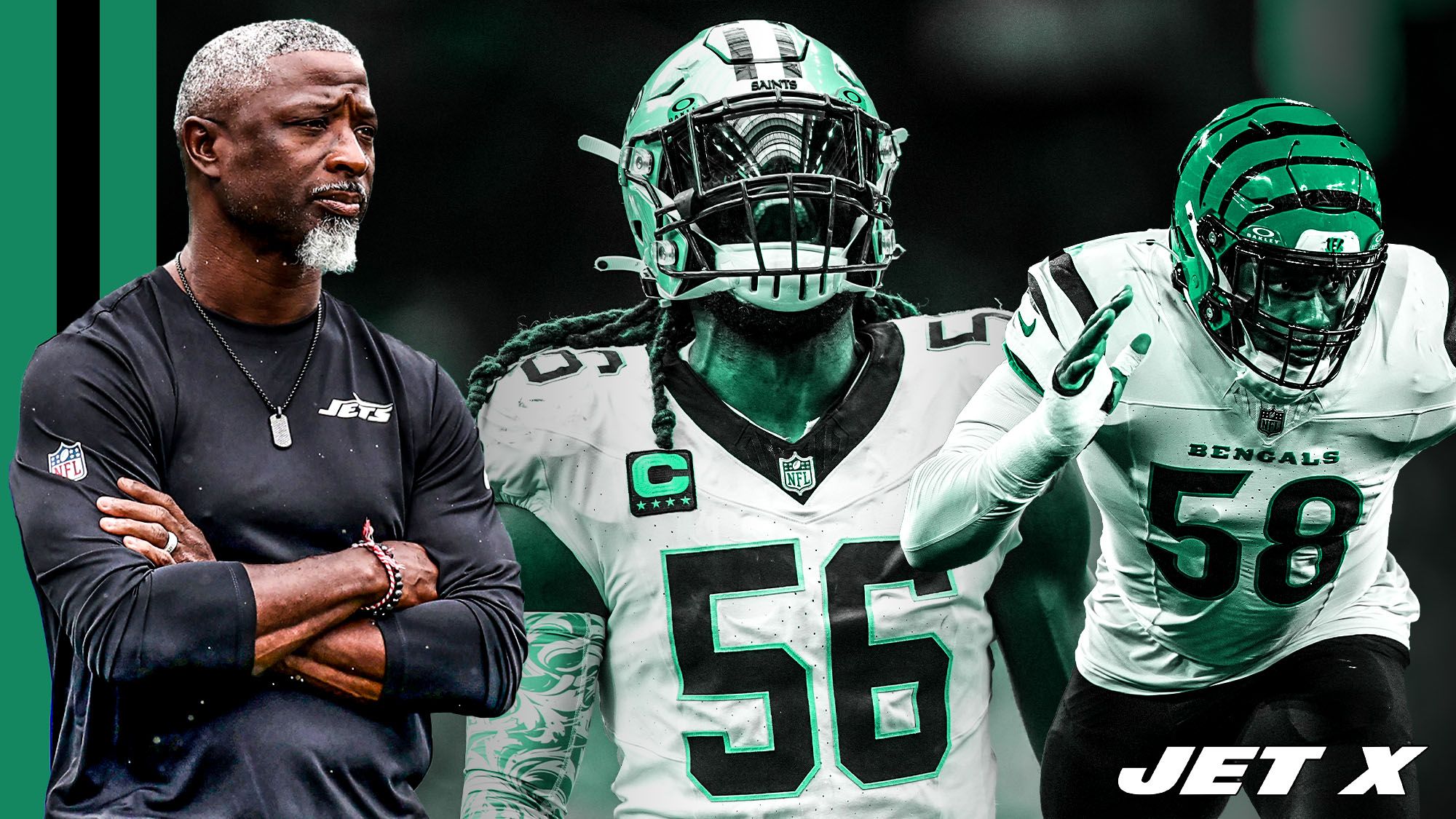
Joseph Ossai and Kingsley Enagbare are a couple of 260-ish-pound edge defenders who thrive as force players against the run. Especially in the case of Ossai, whose 70.1 defensive run grade by PFF ranked 25th out of a qualified 117 players, at least one side of Glenn’s defense is already much more stout against the rush.
Trading Jermaine Johnson for T’Vondre Sweat was the first sign of an altered mentality. Not only did it signal Glenn’s intent to shift more toward odd-front principles, but it did so without dispute.
Although Johnson has no problem playing a physical edge at the point-of-attack, adding Sweat to an interior defensive line group already featuring two 300-plus-pounders — Harrison Phillips and Jowon Briggs — cemented a clear-cut move into the react-attack mold. The David Onyemata signing added a fourth to the room.
No longer would Glenn allow his defense to penetrate like madmen, only to get lost downhill.
Submit to the alpha dogs
Inking 37-year-old Demario Davis extended the theme, only with a different flavor (ranking 13th of a qualified 88 linebackers against the run, per PFF). While Ossai provides violence from the edge, and the four big heavies hold up blocks along the interior, Davis’s intent on sacrificing his body to fill and spill for the betterment of his defense is well-documented.
If that weren’t enough, Davis’s leadership is also obvious—something Glenn’s defense desperately needed. Add safety, Minkah Fitzpatrick, to the bunch, and suddenly, alpha dogs who have no problem biting (on top of barking) are littered throughout all three levels of the unit.
Last but certainly not least is the quarterback.
Let’s face the facts: Glenn failed spectacularly when he kicked Aaron Rodgers to the side for Justin Fields. No matter whose decision it was, in the public’s eyes, Glenn took it on his shoulders.
This time around, the Jets head coach tabbed Geno Smith with the offensive leadership role.
From a “backed into a corner” perspective, it makes sense. After all, Jets fans are well aware of Smith’s plight. First, the 2013 second-round pick’s draft night didn’t go as planned, but that was nothing compared to what followed in Florham Park, N.J., the following three years.
After his latest dip, Glenn pounded the table for a 35-year-old signal-caller who’s intimately experienced with picking himself up and dusting himself off.
The danger of extremes
While the plan on paper looks fine, there’s a danger in every plan. This is especially true with how extreme Glenn seemingly takes his ideas.
Remember, Glenn entered the building last year with a clear team identity in mind. On offense, it was all about rushing the ball with authority and controlling the clock. On defense, he most certainly preached physicality and attitude.
Obviously, Glenn didn’t have the players to execute that plan.
But that begs the question: Why in the world would he set such a plan in motion without the players?
It made sense offensively, with Justin Fields at quarterback. But what makes sense in one’s mind doesn’t automatically jibe with the rapidly changing ways of the NFL. A quarterback whose release and processing is uber-slow will struggle in a league where the three-step, short-passing game is king.
Defensively, it’s tough to know exactly what happened last year with Steve Wilks in charge. For the most part, they simply did not deploy a modern defensive philosophy.
Should Jets fans feel confident in Glenn righting that wrong in 2026?
How will it play out?
The players he brought in will certainly help carry out his arguably old-school defensive ideas. The beef up front should eat up blocks, allowing the second level to roam free. And the edge play should box things in a tidy fashion (forcing it inside).
Are they too beefy, however?
Will they not feature enough lateral quickness on the inside and pass coverage on the second level? Has Glenn traveled the road of the contrasting extreme this time around — once again becoming enamored with an idea, and carrying it out in an imbalanced way?
Does this extreme mindset now carry over to the rest of the offseason and into the 2026 NFL draft? (If so, there’s no question that Glenn is selecting Arvell Reese over David Bailey at No. 2.)
Only time can answer that question.
For now, however, Aaron Glenn’s plan is clear.
With his back up against the wall, he turned to the thing he knows best. He ensured the New York Jets have the best chance of embodying the very nature of his own DNA in 2026.
Unlike last season, the new-look New York Jets have that dog in them. They’ll surely bark, but unlike last year’s team, they’ll most certainly bite.
There’s no other way to analyze it when such a clear history of violence is written on the dog tag. No more cupcake football.
