
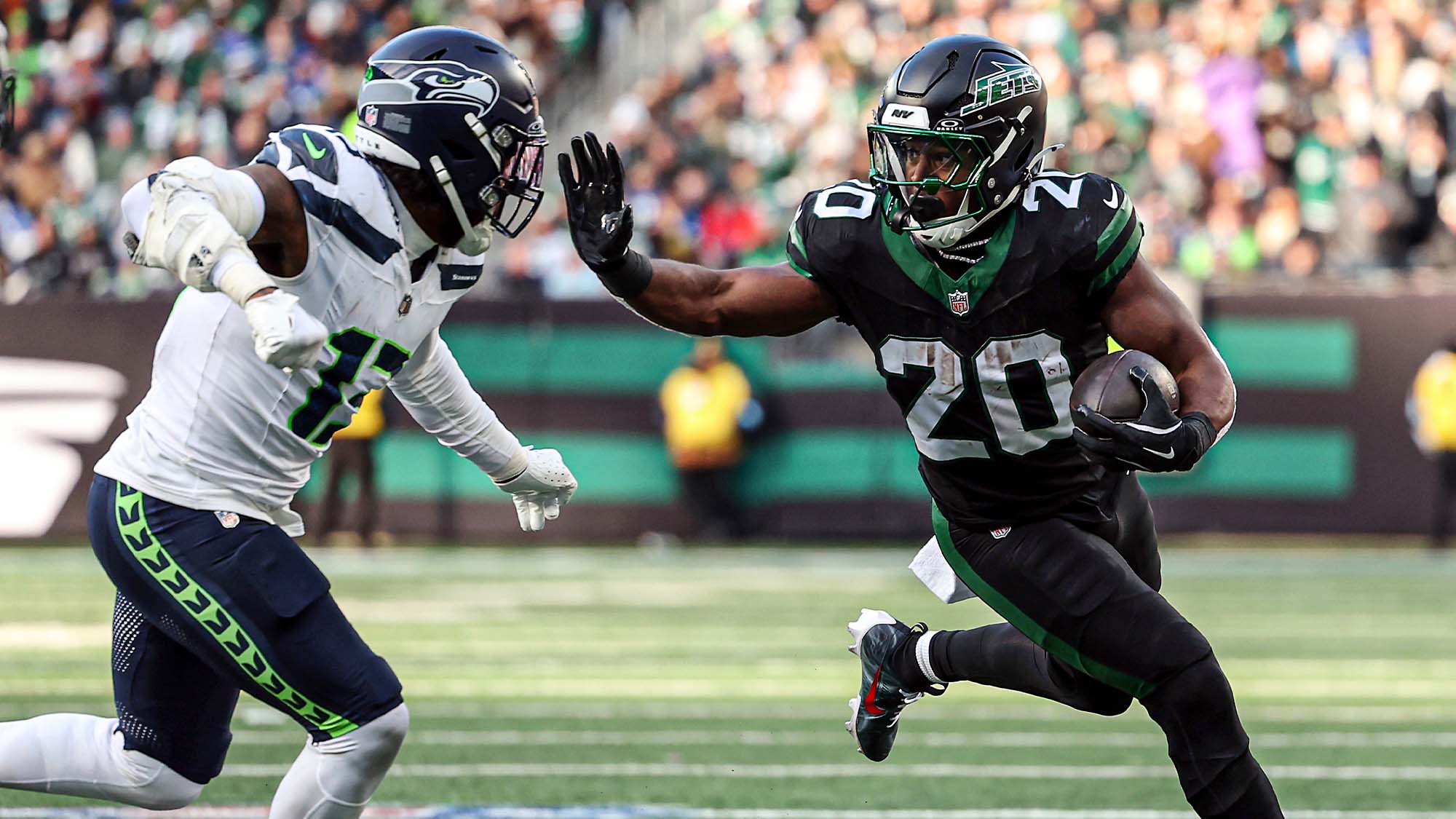
Breece Hall isn’t a top-10 running back in the NFL simply because of his rushing abilities.
As one high-ranking executive told ESPN, it’s Hall’s all-around game that puts him over the top as an elite playmaker in the league.
“True three-down back, creates as a runner and can play in the passing game with good hands,” a high-ranking executive with an NFL team said of Hall, per ESPN’s Jeremy Fowler.
The numbers don’t lie: Hall has been one of the most effective receivers out of the backfield in the NFL since he was drafted in 2022.
Hall is averaging 8.7 yards per reception in his career, placing sixth-best among the 47 running backs with at least 100 targets since 2022. Hall is also sixth in total receptions with 188. The only backs averaging more yards per reception on a greater reception total are Bijan Robinson and Christian McCaffrey.
You would think that a receiver of this caliber would be fed a healthy dosage of targets on an annual basis.
That wasn’t the case for Hall in 2025. He saw just 48 targets, ranking 16th among running backs. His average of 3.0 targets per game was a career-low.
The strangest aspect of Hall’s under-usage in the passing game is that he was actually playing the best football of his career in that phase. He set career-highs in yards per target (7.3) and receiving success rate (54.2%).
Most notably, Hall dropped a career-low one pass, per Pro Football Focus. Drops were a weakness for Hall in the past, as he had a 10.1% drop rate over his first three seasons, but in 2025, he knocked it down to 2.7%.
As good as Hall’s receiving skills have been since the day he suited up in green and white, he was never more efficient than he was in 2025. Yet, the Jets chose to feature him in that phase less than ever before, even with an extreme lack of productivity out of their wide receiver room.
It was perhaps the greatest mistake made by one-and-done offensive coordinator Tanner Engstrand, one that his much more experienced successor, Frank Reich, cannot afford to replicate.
Hall’s target total needs to skyrocket in 2026. That’s not to say New York should give him peak Marshall Faulk usage (110+ targets), but three targets per game is too little for a receiver as good as Hall. A realistic goal could be to get him about five looks per game. That would put him at 85 targets, which would have tied De’Von Achane and Kenneth Gainwell for fifth among running backs in 2025.
Reich has shown in the past that he can join a new team, identify a talented receiving back, and get him his deserved slice of the pie.
Back in 2018, his first season with the Indianapolis Colts, Reich’s offense threw 81 targets to fourth-round rookie running back Nyheim Hines, ranking third on the team and seventh among running backs. Hines finished fifth among running backs with 29 receiving first downs, playing a key role in a Colts offense that ranked fifth in scoring.
As Reich looks to increase Hall’s involvement in the passing game, he should seek to create more than just a few extra screens and checkdowns. Hall has plenty of untapped potential as a downfield threat. His film includes examples of him flexing out wide and creating vertical separation, but not getting targeted.
When the Jets signed Hall to a three-year, $43.5 million contract, it wasn’t just to ride him in the run game. It was a sign of their commitment to him as the all-around engine of their offense.
Expect Hall to see a significant uptick in targets this upcoming season, especially down the field.
