

The NFL offseason is long.
As the months pile up, familiar conversations start to come up time and time again.
In New York Jets land, we’ve talked plenty about whether Geno Smith can bounce back. We’ve talked plenty about David Bailey and whether he was the right pick at No. 2.
Some of the team’s most critical players, though, have flown under the radar.
These three players will be instrumental in determining the Jets’ 2026 success, but aren’t talked about much among Jets fans and analysts.
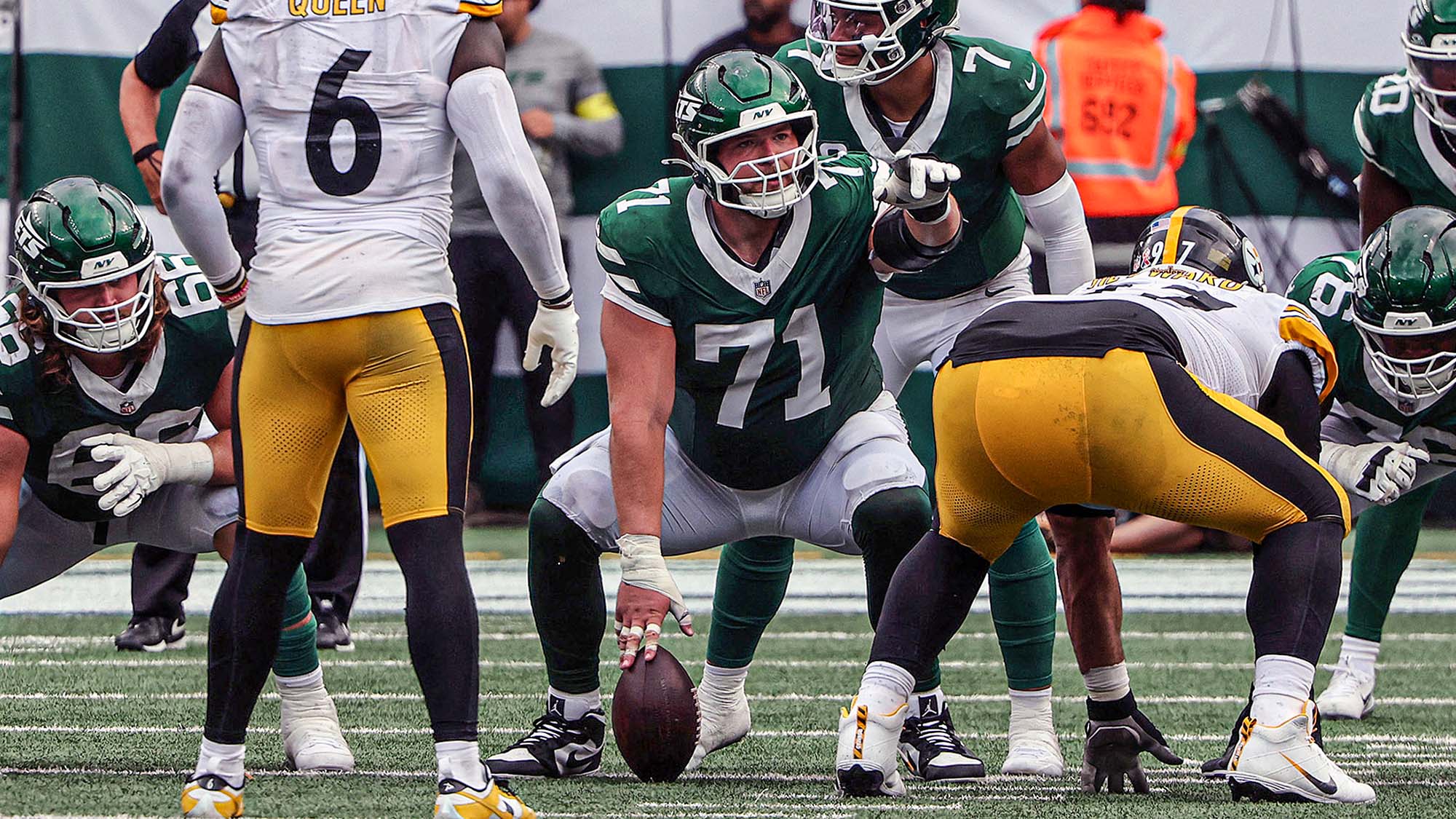
C Josh Myers
They often say an offensive line is only as strong as its weakest link.
Well, center Josh Myers is the weakest link for the Jets, and it isn’t much of a discussion.
In four straight seasons, Myers has graded out as one of the worst starting centers in the NFL at Pro Football Focus. This past season, his 52.9 overall grade ranked 33rd out of 34 qualified centers.
That was also the worst grade among the Jets’ starting five offensive linemen. The only other player below a 66.0 grade was left guard John Simpson (56.9), who has since been replaced with a younger, more productive player in Dylan Parham, who posted a 63.6 mark last season.
There is a lot to be excited about with the Jets’ offensive line. New York has two first-round tackles who are under 24 years old, along with a second-round guard who is entering just his second season as a full-time starter at right guard. All three of those players—Olu Fashanu, Armand Membou, and Joe Tippmann—ascended as the 2025 season progressed, and are poised for sizable leaps in 2026.
But if there’s a gaping hole smack in the middle of the Jets’ offensive line, it could drag down the entire unit.
It seems unrealistic to expect any sort of improvement from Myers, given that he is entering Year 6 and has maintained a consistent track record throughout his career. His overall grade at PFF has ranged from 52.9 to 60.4 in each of his five NFL seasons, so he has never even flirted with being an above-average starter.
Somehow, though, the Jets need Myers to reach a new level in 2026 if they want their offensive line to reach its lofty ceiling. The unit can only be so good if Myers has another lowly season.
New York’s lack of action at center this offseason was puzzling. Myers was signed in 2025 to be a backup. He happened to start all 17 games due to Alijah Vera-Tucker’s season-ending injury before the opener, but Myers did nothing to elevate himself beyond his backup reputation. The position should have been treated like a need.
Now, the Jets are counting on a backup to play like a starter if they want their most promising offensive line in years to fulfill its potential.
DT David Onyemata
Jowon Briggs, T’Vondre Sweat, rookie Darrell Jackson Jr., and even Harrison Phillips seem to generate more conversation out of the Jets’ defensive tackle room than David Onyemata.
But the veteran could be a much bigger difference-maker than many fans realize.
Onyemata is 33 years old, but the Jets didn’t sign him for pennies. He was inked to a one-year, $10.5 million deal.
The veteran is coming off a season in which he graded out as one of the better defensive tackles in the NFL. His 78.2 overall grade at PFF ranked seventh-best among 94 qualified defensive tackles (min. 400 snaps).
Onyemata primarily thrived in the run game, ranking seventh-best at the position with a 74.2 run defense grade, but he was no slouch as a pass rusher, with his 67.1 pass rush grade placing 34th out of 94 qualifiers. That type of two-way ability will make him a player whom the Jets will trust in any situation.
Against the run, Onyemata remains a very active playmaker. His 25 run stops tied for 15th at the position last season, and he did it while missing just two tackles in the run game; he was one of only six defensive tackles with at least 25 run stops and fewer than three missed tackles against the run.
As a pass rusher, you won’t get many splashy plays from Onyemata, who had just 1.0 sack and two quarterback hits last season. He is not the finisher that he was earlier in his career. However, he still knows how to win his reps and cause havoc; his 9.7% pass-rush win rate placed 35th out of 94 qualifiers.
Last season, the Jets’ defensive tackle depth chart was so thin that players like Jay Tufele, Khalen Saunders, and Mazi Smith were playing key roles for chunks of the year. The upgrade from those players to Onyemata is much larger than people are giving it credit for, and it will be palpable when the Jets take the field for their first gameday of the season.
OT Chukwuma Okorafor
Jets fans didn’t have to worry about Chukwuma Okorafor last season, as starting tackles Olu Fashanu and Armand Membou combined to miss just seven snaps.
In a perfect world, the Jets would love for that scenario to play out again in 2026. But this is the NFL. There’s a reason that the perfect durability of the Jets’ opening-week offensive line in 2025 was noteworthy; it was an extremely rare occurrence.
The harsh reality is that the Jets’ tackles may not start all 34 games again in 2026. That means Okorafor, who re-signed with the team on a one-year, $1.5 million deal, might have to start at some point.
Okorafor and Max Mitchell will battle it out to be the next man up if a starting tackle goes down. Last season, it was actually Mitchell who replaced Fashanu for seven snaps during a brief stint against Dallas, which indicates that New York preferred Mitchell as the next man up at left tackle.
Okorafor, though, is probably the favorite to back up Membou on the right side. Okorafor spent six seasons as the Steelers’ starting right tackle, but when the Patriots moved him to left tackle in 2024, he couldn’t even get through one half before being benched and leaving the team. The Jets might view Okorafor as a pure right tackle.
Membou has a chance to be one of the best players on the Jets’ entire roster this year. If he goes down, he will leave massive shoes to fill.
It is unrealistic to expect Okorafor to come close to matching Membou’s impact, but he has to come as close as possible for the Jets’ offense to stay afloat. After all, that’s what backups are measured by. No backup is expected to match the performance of the man in front of him; if they were capable of doing that, they would be starting. What separates the great NFL teams from the bottom-feeders is having depth that ensures the drop-off is as minimal as possible.
Every NFL team will deal with injuries this season. Some teams will collapse when those injuries occur. Other teams will get just enough competence from their backups to outlast the rest of the league.
The Jets need Okorafor to help them join the latter category.
Too often, the Jets are among the teams that suffer one or two major injuries and use them to excuse an entire season of misery. Meanwhile, you see teams like the 2024 Lions and the 2025 Niners who have half their roster torn apart and still win most of their regular season games. Depth is the differentiator.
Glenn was an integral part of that 2024 Lions team. He coached the Detroit defense to be one of the best in the league despite not having its best player, Aidan Hutchinson, for most of the season. From this experience, Glenn knows the value of quality depth as well as anyone.
The Jets are counting on Okorafor as the primary backup to one of their best players. He must step up to the plate when called upon.
